

For the trade lawyers, as you read this. What does SunPower buying SolarWorld and Suniva asset sale mean for a global tariff/duty settlement? Does SunPower get to speak for SolarWorld on this issue now?
Not All Bad Deeds Go Punished. SunPower has entered into an agreement to acquire the shares of SolarWorld Americas, Inc. This took most of the solar industry by surprise, myself included, when the news broke before the market opened yesterday. The market has reacted positively with a 11% bump in stock price based on the notion that SunPower has a way to get around 201 tariffs. A few hours before those news broke, the comments about the 201 exclusions came out in which SolarWorld supported SunPower’s request for exclusion which seemed odd given the market segment, residential, that both companies operate in.
Reading Between The Lines. I don’t actually think this is about 201 tariffs. If SunPower were to acquire SolarWorld for 201, why not wait until the exclusion was rejected? I think that SolarWorld was in a bad place and needed a buyer which means that the price was right. At the same time, SunPower needed to add a product that could both be labeled as Made in the USA and cheaper. SunPower installers love the premium product but all of them carry a second product so they don’t lose deals purely based on price. Now, SunPower could offer a two tiered offering into its dealer network, which is as good as it gets. To summarize, SunPower buying SolarWorld is more of a play for residential market share than 201 tariffs.
Future Of Suniva. In the ongoing bankruptcy proceedings for Suniva, SQN has let the court know that they are selling some (or all) of the companies manufacturing equipment. This means that most of the value of the company aside from any intellectual property is leaving the company, if a buyer comes around. The 201 trade case is ending much quicker than it started, we haven’t even gotten to the point where prices can prop up local manufacturing.
The Business Of Solar. The annual solar means business report is out and Target is the big leader, adding 40MW in 2017 and the first to reach 200MW. Congrats to the Target team, many of whom are readers, for showing great corporate leadership. The other takeaway is Walmart putting the brakes on its program or at least taking a hiatus. Would be interesting to hear what caused the slowdown of deployment.
The Charging Infrastructure. Now VW is getting into the race to deploy more charging infrastructure. I question the OEM specific nature of this and why the utilities aren’t out front leading the development. When I go to my local Whole Foods, there is a charging station there that is free for me to use, a benefit for Whole Foods since I stay in the store longer than I otherwise would.
Opinion
News
Opinions:
Have a great day!
Yann
By Frank Andorka, Senior Correspondent What Happened:And now in this corner, from the other end of the Section 201 tariff case, comes the news that Suniva is literally being sold for parts by its creditor SQN Capital Management.:
By Frank Andorka, Senior Correspondent What Happened:And now in this corner, from the other end of the Section 201 tariff case, comes the news that Suniva is literally being sold for parts by its creditor SQN Capital Management.:
- Who could have seen this coming? (Everyone. Everyone saw this coming.)
- SQN Capital Management is the same outfit that famously offered to sell Suniva off to the Chinese Chamber of Commerce for a cool $55 million left on a Central Park bench at 3 a.m.
- Now they've gotten the OK to sell off the manufacturing equipment at a public auction, does anyone really think they're going to plow the money back into the company to restart production? No. No one does.
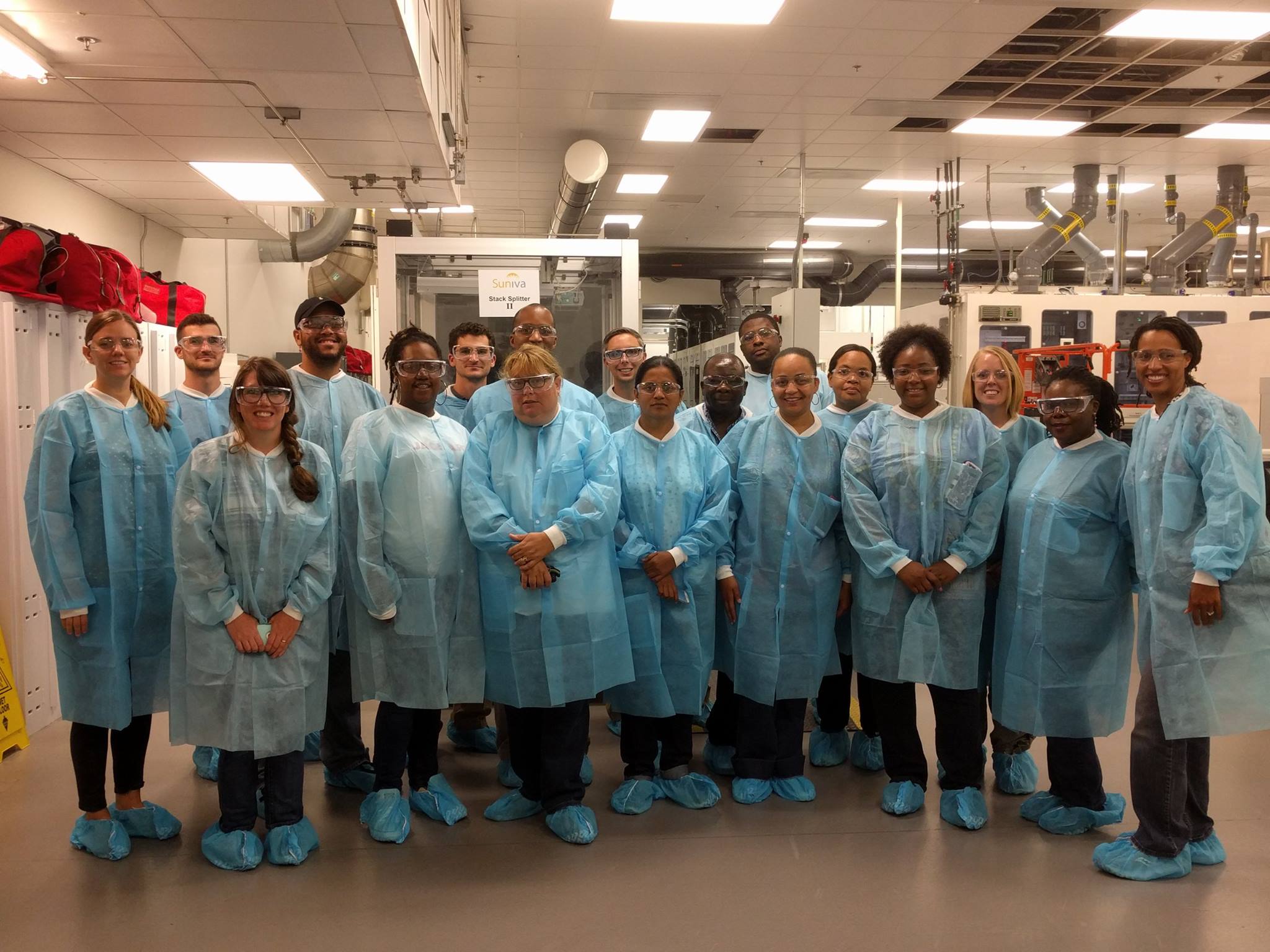 From Suniva's Facebook page, that day they all got into scrubs and delivered a solar panel by hand.[/caption]
SolarWakeup’s View: Lordy, when it rains it pours.
From Suniva's Facebook page, that day they all got into scrubs and delivered a solar panel by hand.[/caption]
SolarWakeup’s View: Lordy, when it rains it pours.
By Frank Andorka, Senior Correspondent What Happened:And so it ends. What was once the emblematic brand of the U.S. solar industry - SolarWorld - is gone, as Sunpower has announced it will snap up at least the company's assets.:
By Frank Andorka, Senior Correspondent What Happened:And so it ends. What was once the emblematic brand of the U.S. solar industry - SolarWorld - is gone, as Sunpower has announced it will snap up at least the company's assets.:
- As much as SolarWorld the corporation deserves scorn for its destructive behavior over the past 12 months, there really isn't any such thing as SolarWorld as a corporation.
- In reality, the company is made up of people - real, flesh-and-blood people - and if Sunpower's purchase of the company saves their jobs, then we can't be anything but happy here at SolarWakeup.
- But don't expect us to be happy that the executives at the company will likely be walking away with golden parachutes after leaving a swath of destruction across the industry to the tune of 9,800 jobs and counting.
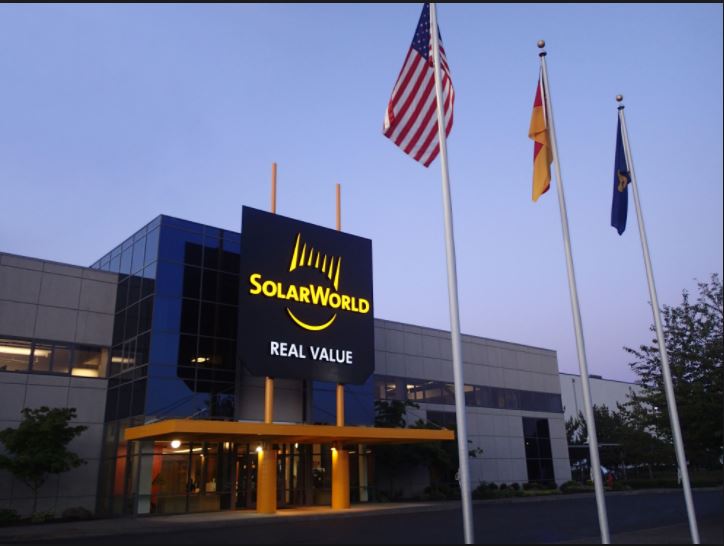 SolarWakeup’s View: No one is happier than I am to be writing this story, for two reasons. First, it means I will never have to type the name SolarWorld ever again, once this story is over. Second, it means the more than 300 employees working at SolarWorld's Oregon facility may have their jobs saved - and I am all about actually saving jobs.
Now it should be noted that as happy as I am about saving those jobs on one of the most beautiful states in the country (and they make a mean Pinot Noir in the Willamette Valley), it is a bit sobering to realize that those jobs came in part at the cost of 9,800 jobs (and counting) thanks to SolarWorld's unconscionable decision to support Suniva's "if-we're-going-down, we're-taking-the rest-of-you-with-us" trade action last year.
SolarWakeup’s View: No one is happier than I am to be writing this story, for two reasons. First, it means I will never have to type the name SolarWorld ever again, once this story is over. Second, it means the more than 300 employees working at SolarWorld's Oregon facility may have their jobs saved - and I am all about actually saving jobs.
Now it should be noted that as happy as I am about saving those jobs on one of the most beautiful states in the country (and they make a mean Pinot Noir in the Willamette Valley), it is a bit sobering to realize that those jobs came in part at the cost of 9,800 jobs (and counting) thanks to SolarWorld's unconscionable decision to support Suniva's "if-we're-going-down, we're-taking-the rest-of-you-with-us" trade action last year.
The (Not So) Dark Side Of Solar. If you follow energy conversations on Twitter, there is a set of a half dozen energy Phd’s that educate (troll) solar conversations quite a bit. Yesterday, when I saw the article from Varun Sivaram, I rolled my eyes but then you made it the most clicked link. The oped is non-sense, Frank does the breakdown, and I’d be happy to defend my calling it non-sense. The danger is the real estate Varun is getting his message into, namely Brookings blog and Washington Post. Solar folks will read the article and know that it wasn’t factions of the solar industry fighting for tariffs, just two bankrupt companies. Solar may be able to get itself into political conversations but definitely doesn’t have political clout. Look at South Carolina, what did Varun want solar to argue for in addition to the NEM cap increase that solar didn’t get? Varun is anti distributed generation and against the ITC, in short, his message is to co-opt the public opinion support solar enjoys for more of the same 20th century message.
Storage At The State Level. State level energy storage targets are close to topping 10GW in the first real year that these legislative and executive order targets are proposed. So what’s next with these targets? Should I raise my hand and say that I have projects ready for construction with project finance capital and need a revenue stream? Aside from the SMART program in MA, we are still in a likely regulator process that will require pricing signals to happen. The money is still lacking on the energy storage side, a problem I am working to solve for you, but project pipelines are also nonexistent with any real scale. More announcements on the storage investment capital coming soon.
Sunny Insurance. Farmers spend as much of their time and resources hedging and forward selling their output as they do actually farming. As the weather becomes the unknown, the agricultural market has created insurance products to minimize the risk of weather. Solar is now being served by similar products, like kWh Analytics’ revenue put, that limits the risk to debt and ideally lowers the cost of capital. Look for credit default products to be created as well, another way that C&I could be fixed.
Private Equity Buys Into Solar. Conti Solar, part of Conti Group, is selling a majority stake of the business to ARES EIF, the private equity group’s energy infrastructure fund. Management will stay in place and financial terms were not released by the companies. Conti Solar installed 175MW in 2017 and if I were to guess, this is as much as a focus on growing the EPC business as it is creating a pipeline for projects to invest in. This is what the board room would call a ‘platform play’.
Completing The Turnaround. Enphase is getting positive reviews from Wall Street analysts. The company has struggled a bit in past years but now sees light at the end of the tunnel. 2017 was a tough year for residential and large customers limited their growth so the distribution channel had to come back to life, and it has. The democratization of capital available to local installers is also helping residential solar bounce back in a big way. So as costs decline, Enphase is at the center of the installation that adds value to the homeowner, maybe even with some nifty consumer focused data, creating real value to the market. Turnarounds are hard and turnarounds in solar are more so, hats off to the Enphase team to execute.
Opinion
News
Opinions:
Have a great day!
Yann