

By Frank Andorka, Senior Correspondent What Happened:The clock is ticking on the future of DTE Energy's $1 billion natural gas boondoggle, with a decision expected by Friday.
By Frank Andorka, Senior Correspondent What Happened:The clock is ticking on the future of DTE Energy's $1 billion natural gas boondoggle, with a decision expected by Friday.
 Is the image of the sun setting on a utility pole too heavy handed? I worry it's a little heavy handed.[/caption]
SolarWakeup’s View: In what has become a battle between the forces of a dominant utility and the solar industry, the fate of DTE Energy's proposed $1 billion natural gas plant could be decided as late as Friday. And don't think for a second solar advocates around the country aren't hanging on this decision like a cliffhanger on the season's finale of This Is Us.
Is the image of the sun setting on a utility pole too heavy handed? I worry it's a little heavy handed.[/caption]
SolarWakeup’s View: In what has become a battle between the forces of a dominant utility and the solar industry, the fate of DTE Energy's proposed $1 billion natural gas plant could be decided as late as Friday. And don't think for a second solar advocates around the country aren't hanging on this decision like a cliffhanger on the season's finale of This Is Us.
Trump Tariff Impacts. In Germany, a company must file for insolvency at a much earlier date than the comparable situation in the US. While the German division of Schletter has been in self-administration for a little over a month, it appears that Schletter US has closed its doors, at least temporarily. Several employees and sources close to the situation advised that they were told to stay away from work. Emails and phones have been disconnected or go unanswered. Schletter has been a racking provider for as long as I’ve been in solar but with a large staff, 201 and commodity tariffs, it may have been too much for the parent company to continue funding. We’ve reached out to Schletter representatives without success and will update you once we hear from them. Overall, this appears to represent a broader need for consolidation in the racking market. While selling widgets is a profitable venture, there may be too many to choose from and too many with a market share that is too small causing margin pressure for large companies like Schletter.
MA Wants Storage, Needs To Act. MA may have the best market setup for energy storage after California with the start of the SMART program. That being said, the regulators and interconnecting utilities still have a lot of work ahead for them if they actually want storage to be built. If they do this correctly, storage will be built on every single solar project and I’d be happy to finance every storage installation in MA and elsewhere. (If you need me call me) Especially when it comes to DC-coupled energy storage, the interconnection is already in place, requiring a new filing makes no technical sense and only serves to dissuade developers from adding storage. So if MA wants more storage, then align rules with goals.
$1.9Billion For Solar Infrastructure. (Just kidding) From here on out, when I see a request for infrastructure improvements like a $1.9billion gas plant, I am going to point out the interconnection improvements to the network, like building a new substation, solar has to take on. I understand that energy is central to our economy and it must be reliable but it must also be clean and cost effective in the long term. Investing into infrastructure for 50 years going forward at consumer expense is not the most effective way to use rate base capital.
Bloomberg Donates Yesterday’s Earnings. Hopkins alum and notable environmental leader, Michael Bloomberg, is making up the $4.5mm shortfall that is left behind after the US departure from the Paris agreement. The money goes to the UN Climate Change Secretariat.
Certain Companies’ Power Plants. Axios’s Amy Harder has the inside the White House look at how Trump views the energy markets. Sometimes what you expect to hear is exactly what Amy is reporting in this article. Certain power plants by certain companies. When solar is generated on my roof, at least you won’t expect the government to shine light on the modules to generate more electricity. Libertarians rejoice.
Opinion
News
Opinions:
Have a great day!
Yann
By Frank Andorka, Senior Correspondent What Happened:Sources close to the situation have told SolarWakeup that Schletter, the German solar racking company going through insolvency (what bankruptcy is called in Germany) at home, is close to closing its U.S. operations.
By Frank Andorka, Senior Correspondent What Happened:Sources close to the situation have told SolarWakeup that Schletter, the German solar racking company going through insolvency (what bankruptcy is called in Germany) at home, is close to closing its U.S. operations.
 SolarWakeup’s View: Though there has been no official announcement, multiple sources close to troubled racking company Schletter say the U.S. subsidiary has closed its doors. Calls to U.S. headquarters' main number and to the marketing manager go directly to generic voicemail, and calls to the office and cell phones of the company's vice president of sales reach recordings saying they have been disconnected.
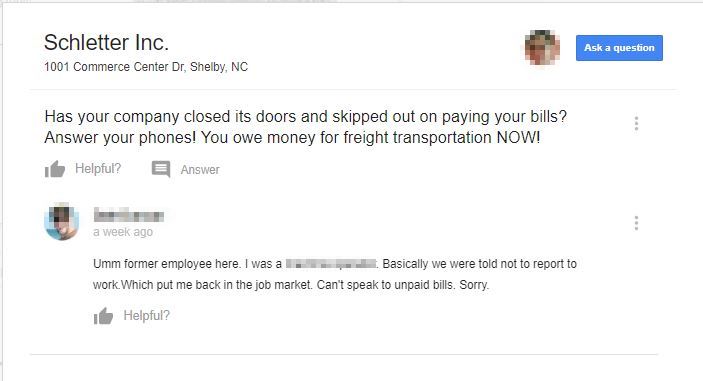 It should be noted that with no WARN Act notices have been filed by the company.
The Worker Adjustment and Retraining Notification Act of 1988 (the "WARN Act") is a U.S. labor law which protects employees, their families, and communities by requiring most employers with 100 or more employees to provide 60 calendar-day advance notification of plant closings and mass layoffs of employees, as defined in the Act.
Schletter's Germany parent company filed for bankruptcy in March.
Schletter US may well be another casualty in the needless and mindless trade war the Trump Administration had declared on the world, starting with his announcement of tariffs on solar modules in January and followed by tariffs on steel and aluminum, all of which would have had deleterious effects on Schletter's main business.
The racking-and-mounting segment of the U.S. solar industry, of which Schletter USA was a part, spoke out as a group forcefully and often against the trade complaint brought by bankrupt solar module manufacturer Suniva and later joined by SolarWorld in an attempt to jack up their valuation in preparation for sale.
Last week, SunPower announced it had purchased SolarWorld's assets, and Suniva's main creditor SQN Capital Management announced it was selling off all the company's manufacturing equipment. So neither of the two combatants of the idiotic tariff battle are likely to exist in six months.
But the effects of their ridiculous battle will be felt long into the future and, by all accounts, have claimed the employees of racking giant Schletter.
SolarWakeup will continue to monitor this situation and update the story as necessary.
More:
We’re Happy For SolarWorld Employees – But That’s It
Suniva Being Sold For Parts (Literally), Just Like We Said
It should be noted that with no WARN Act notices have been filed by the company.
The Worker Adjustment and Retraining Notification Act of 1988 (the "WARN Act") is a U.S. labor law which protects employees, their families, and communities by requiring most employers with 100 or more employees to provide 60 calendar-day advance notification of plant closings and mass layoffs of employees, as defined in the Act.
Schletter's Germany parent company filed for bankruptcy in March.
Schletter US may well be another casualty in the needless and mindless trade war the Trump Administration had declared on the world, starting with his announcement of tariffs on solar modules in January and followed by tariffs on steel and aluminum, all of which would have had deleterious effects on Schletter's main business.
The racking-and-mounting segment of the U.S. solar industry, of which Schletter USA was a part, spoke out as a group forcefully and often against the trade complaint brought by bankrupt solar module manufacturer Suniva and later joined by SolarWorld in an attempt to jack up their valuation in preparation for sale.
Last week, SunPower announced it had purchased SolarWorld's assets, and Suniva's main creditor SQN Capital Management announced it was selling off all the company's manufacturing equipment. So neither of the two combatants of the idiotic tariff battle are likely to exist in six months.
But the effects of their ridiculous battle will be felt long into the future and, by all accounts, have claimed the employees of racking giant Schletter.
SolarWakeup will continue to monitor this situation and update the story as necessary.
More:
We’re Happy For SolarWorld Employees – But That’s It
Suniva Being Sold For Parts (Literally), Just Like We Said
By Frank Andorka, Senior Correspondent What Happened:After languishing for a decade in relative obscurity, it might finally be time to dust off a Navigant Consulting report on the solar capacity of Florida, now that the Public Service Commission (FPSC) has made third-party leasing a reality.
By Frank Andorka, Senior Correspondent What Happened:After languishing for a decade in relative obscurity, it might finally be time to dust off a Navigant Consulting report on the solar capacity of Florida, now that the Public Service Commission (FPSC) has made third-party leasing a reality.
 SolarWakeup’s View: Well, 2020 is no longer a realistic goal, but the Florida report created for the state's Public Service Commission gives a tantalizing glimpse into what the future of the solar industry could be.