

Solar Goes For Meghan Nutting! We are just a few weeks away from the June 26th primary election for Meghan Nutting. Meghan is running for Colorado’s 5th District in the State House and she is also the VP of Public Policy for Sunnova. She’s been a solar advocate to advance our industry and now is the time for all of us to come together and put Meghan into the State House to represent Denver. First, help her raise money and send $5, which you can do here. Second, if you have friends in Denver, you have to get them to help her knock on doors. This race gets decided in the primary so we have just a few weeks away. If you want to learn more about Meghan, you can listen to my interview with her.
Elon’s Twitter Rant, My 2 Cents. Elon went on a twitter rant yesterday about the media. One of his points was that much of the coverage is negative and when it comes to all things Tesla, negative headlines get a lot of clicks. How do I know? I have the unique vantage point of being able to compare many outlets and many headlines. Unlike publications that can only compare one headline over another through internal A/B testing, we have the ability to track headlines across publications. The truth is that headlines matter more to readers than the publication and any story that is about a bankruptcy, problem or negative issue gets significantly more traction than anything else. Case in point, the story this week about Cypress Creek cancelling projects was clicked by almost every person that clicked any story at all.
My First Solar Project. Hats off to Portland for going out for an RFP to drive the best deal possible for its customers. Two of my first solar projects were in Portland, one for Nike and one with Portland Gas and Electric. Fun times!
Value Of Solar, Infinite. $20k to go. $20k left to raise to help save over 200 babies over the next year in a single hospital in Sierra Leone. Because of unreliable power, almost half of the babies that go into the NICU in the hospital pass away. $20k is less than $5 per reader today, so skip the Starbucks and send the money. Please!
New Jersey Bills Signed. Frank has your coverage on the bill signing in NJ, keeps an important market going forward and creates a few new opportunities for solar to develop projects.
Big Oil + Storage + Solar. Another oil investment into storage, this time Shell into Sonnen. Keep watching the trend of auto, IPPs and oil converging around solar + storage. Sparkspread reported that a storage developer with pipeline went into market for acquisition yesterday, if you have info about that, let me know.
Opinion
News
Opinions:
Have a great day!
Yann
By Frank Andorka, Senior Correspondent
By Frank Andorka, Senior Correspondent
[caption id="attachment_9214" align="aligncenter" width="900"] Atlantic City, New Jersey, might be able to expand its use of solar now that two new bills have been signed into law by Governor Phil Murphy.[/caption]
It took longer than many observers expected, but New Jersey Governor Phil Murphy signed into law bills that will boost clean energy production in his state, with solar playing a central role in this growth.
Murphy also issued Executive Order No. 28, which formally recognized climate change as a threat to the state and has established a multi-departmental committee to establish a 2019 Energy Master Plan. The mandate specifically cites improving both wind and solar development as one of the key goals of the Master Plan moving forward.
The governor had run on an aggressive platform of boosting clean energy production in the state.
"We're gratified to see Governor Murphy fulfill his campaign promises to support and expand clean energy in the state, especially solar," said Jesse Grossman, CEO of N.J.-based Soltage. "We look forward to playing our part in building new solar infrastructure with these new guidelines in place and expand New Jersey’s role as one of the leading solar states in the country."
Atlantic City, New Jersey, might be able to expand its use of solar now that two new bills have been signed into law by Governor Phil Murphy.[/caption]
It took longer than many observers expected, but New Jersey Governor Phil Murphy signed into law bills that will boost clean energy production in his state, with solar playing a central role in this growth.
Murphy also issued Executive Order No. 28, which formally recognized climate change as a threat to the state and has established a multi-departmental committee to establish a 2019 Energy Master Plan. The mandate specifically cites improving both wind and solar development as one of the key goals of the Master Plan moving forward.
The governor had run on an aggressive platform of boosting clean energy production in the state.
"We're gratified to see Governor Murphy fulfill his campaign promises to support and expand clean energy in the state, especially solar," said Jesse Grossman, CEO of N.J.-based Soltage. "We look forward to playing our part in building new solar infrastructure with these new guidelines in place and expand New Jersey’s role as one of the leading solar states in the country."
By Frank Andorka, Senior Correspondent
By Frank Andorka, Senior Correspondent
 In an industry with some tough stories to tell these days, sometimes it's worth pausing and savoring a story that is undeniably and unalterably good - and such is the case with Project Bo.
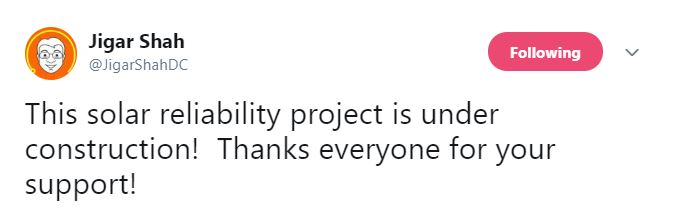
The project, designed to purchase, install and maintain a 20kW solar and battery system to provide an uninterrupted 24/7 power supply to the oxygen concentrators and baby warmers at Bo Government Hospital's Neonatal Intensive Care Unit, is finally under construction after raising 82% of the funds necessary to complete the project.
They are currently around $20,000 away from reaching 100% of their goal, thanks to the Liebreich Foundation, the U.K.-based charity heading up the fundraising drive.
In an industry with some tough stories to tell these days, sometimes it's worth pausing and savoring a story that is undeniably and unalterably good - and such is the case with Project Bo.
The project, designed to purchase, install and maintain a 20kW solar and battery system to provide an uninterrupted 24/7 power supply to the oxygen concentrators and baby warmers at Bo Government Hospital's Neonatal Intensive Care Unit, is finally under construction after raising 82% of the funds necessary to complete the project.
They are currently around $20,000 away from reaching 100% of their goal, thanks to the Liebreich Foundation, the U.K.-based charity heading up the fundraising drive.
 According to the Project Bo website:
An average of 17 babies die each month at Bo Government Hospital's Neonatal Intensive Care Unit in Sierra Leone. That’s approximately 25% of all babies admitted. Many of these deaths are caused by the lack of one basic provision – a reliable power supply. It is these babies Project Bo has been established to support. Through the provision of solar and battery technology, a secure power supply will safeguard the most vulnerable of babies who are reliant on life-saving equipment.The use of solar makes sense when you realize how electricity-poor Sierra Leone is. The website continues:
Bo is the third largest city in Sierra Leone and home to about half a million people, most of whom live below the poverty line. It also has one of the world’s worst infant mortality rates. Only 13% of the population receives power, and many areas have no grid access at all. Frequent power blackouts and sparse and sporadic coverage greatly hinders the healthcare system from providing basic care. Furthermore Ebola has severely impacted the health care system care for neonates is particularly challenging.While it's great to see the solar industry rally around such a great cause, it bears repeating that the job isn't done yet. The project is still $20,000 short - let's see if we can't make that money happen for them as soon as possible. More: Project Bo Website With Donation Button https://youtu.be/wYkw-PBhRro
By Frank Andorka, Senior Correspondent
By Frank Andorka, Senior Correspondent
[caption id="attachment_9490" align="aligncenter" width="1280"] The new Solar Finance Council will continue to work on lowering the cost of capital and expand the investor base so more solar can be deployed in more places.[/caption]
Financing is often the most difficult part of getting a solar deal done, and lower the costs of capital is one of the keys to unlocking solar's full potential. To that end, one man with experience in researching the problem has created a new working group to address just those issues.
Called the Solar Finance Council (SFC), the group is being headed by Mike Mendelsohn as executive director.Mendelsohn previously led the Solar Energy Industries Association’s (SEIA) work in project finance and capital markets. Prior to SEIA, he established the Solar Access to Public Capital (SAPC) working group at the National Renewable Energy Laboratory. Unlike his previous endeavors, however, the SFC will remain independent.
The new Solar Finance Council will continue to work on lowering the cost of capital and expand the investor base so more solar can be deployed in more places.[/caption]
Financing is often the most difficult part of getting a solar deal done, and lower the costs of capital is one of the keys to unlocking solar's full potential. To that end, one man with experience in researching the problem has created a new working group to address just those issues.
Called the Solar Finance Council (SFC), the group is being headed by Mike Mendelsohn as executive director.Mendelsohn previously led the Solar Energy Industries Association’s (SEIA) work in project finance and capital markets. Prior to SEIA, he established the Solar Access to Public Capital (SAPC) working group at the National Renewable Energy Laboratory. Unlike his previous endeavors, however, the SFC will remain independent.