

I hope you enjoyed your week and if you attended, Intersolar. Have a great weekend and see you on Monday!
Exxon Diverges From ALEC. On its own, Exxon leaving the anti-renewables group in ALEC probably doesn’t mean very much, especially when Exxon doesn’t come out and say why it didn’t renew its membership. If this becomes a trend it could mean that the values alignment with the membership group hurts members when they try to hire or acquire talent. If Exxon is to follow the oil industry with investments and business units in renewables and electric vehicles, then the policy initiatives by ALEC may be partly the reason. Consider this a data point not pointing to a trend, just yet.
Big Plans In PA. Pennsylvania has the potential to be a great solar market. Land availability, reliable grid, low install prices and access to PJM in most areas. What it lacks is some of the foundational market support including some access to SRECs. A draft plan from the state environmental agency is trying to push the solar market forward with a plan to get to 10% of retail sales which would equate to 15GW of solar up from 300MW today. Let’s give them some support to get that done.
Greening Supply Chain. There have been several jobs posted over the past 6 months by Apple that vaguely sounded like they were solar jobs but always spoke about supply chain. One of those jobs had a requirement to be able to work in China and speak the language. This announcement about a solar fund adds additional color. It is no longer enough for this manufacturer to be ‘solar powered’, it also wants to make sure the inputs to the business are aligned with its own values with renewable energy. The other piece, which I’d like to see be more vocal, would be to get the tech giants more involved to open the markets for the solar industry. The instant permit process would be a great start, tech companies should be behind that endeavour so that consumers and customers have the same access to solar as the corporation does.
NY Times Learns About Solar. A local story for the NY Times covering the community solar market and the access to solar it gives to folks in dense areas. Any national coverage for solar that isn’t covering a fight solar has to be in to increase access is a positive one and should make people ask why they don’t have the same choice. Community solar should be a national option, the separation of site to user is the best way and most efficient way to let consumers get 100% solar energy at a very competitive rate. This way consumers can put solar on their home if possible then buy additional energy as their usage demands.
Have a great day!
News
Opinions:
Have a great day!
Yann
Big thanks to the warm Bay area welcome from many of you. I appreciate you coming by and saying hello. Back to more robust summaries next week!
Fox, Denies Being A Fox. Wheeler doesn’t like being called a coal lobbyist and the assumption that follows that fact. If you bring a fox into the henhouse and tell the fox that maybe the hens should be eaten, then what are the hens supposed to assume is going to happen? Wheeler was a coal lobbyist. Trump wants to bail coal out and build coal power plants. What does Wheeler expect people will think?
Fighting The Good Fight. I had the pleasure of being with IREC yesterday to get an update on their important work. IREC isn’t always the most visible policy group but when it comes to building the foundation of solar markets, assume IREC was there early. Interconnection for solar and storage, training firefighters and more, IREC is doing it and you should support in any way you can.
Energy Storage Grows. Frank sat in on the Energy Storage Associations presentation yesterday. With GWh scale storage being announced, my guess is that this association grows alongside the market.
Have a great day!
News
Opinions:
Have a great day!
Yann
By Frank Andorka, Senior Correspondent
By Frank Andorka, Senior Correspondent
As you might imagine, the word on everyone's lips at Intersolar North America - in addition to solar - is storage. Specifically, the question is how much storage can the United States expect to have installed and how quickly it can come. Fortunately, Kelly Speakes-Backman, CEO of the Energy Storage Association, was attending the show to answer exactly those kinds of questions. Speakes-Backman informed the audience at the insanely broadly titled "The Future of PV" session that the United States installed 1 GW of storage last year and is on pace to double that this year to 2 GW, though she was quick to emphasize time and again that she is not just talking batteries - the storage method on which most people in the room and in the general solar industry are focused.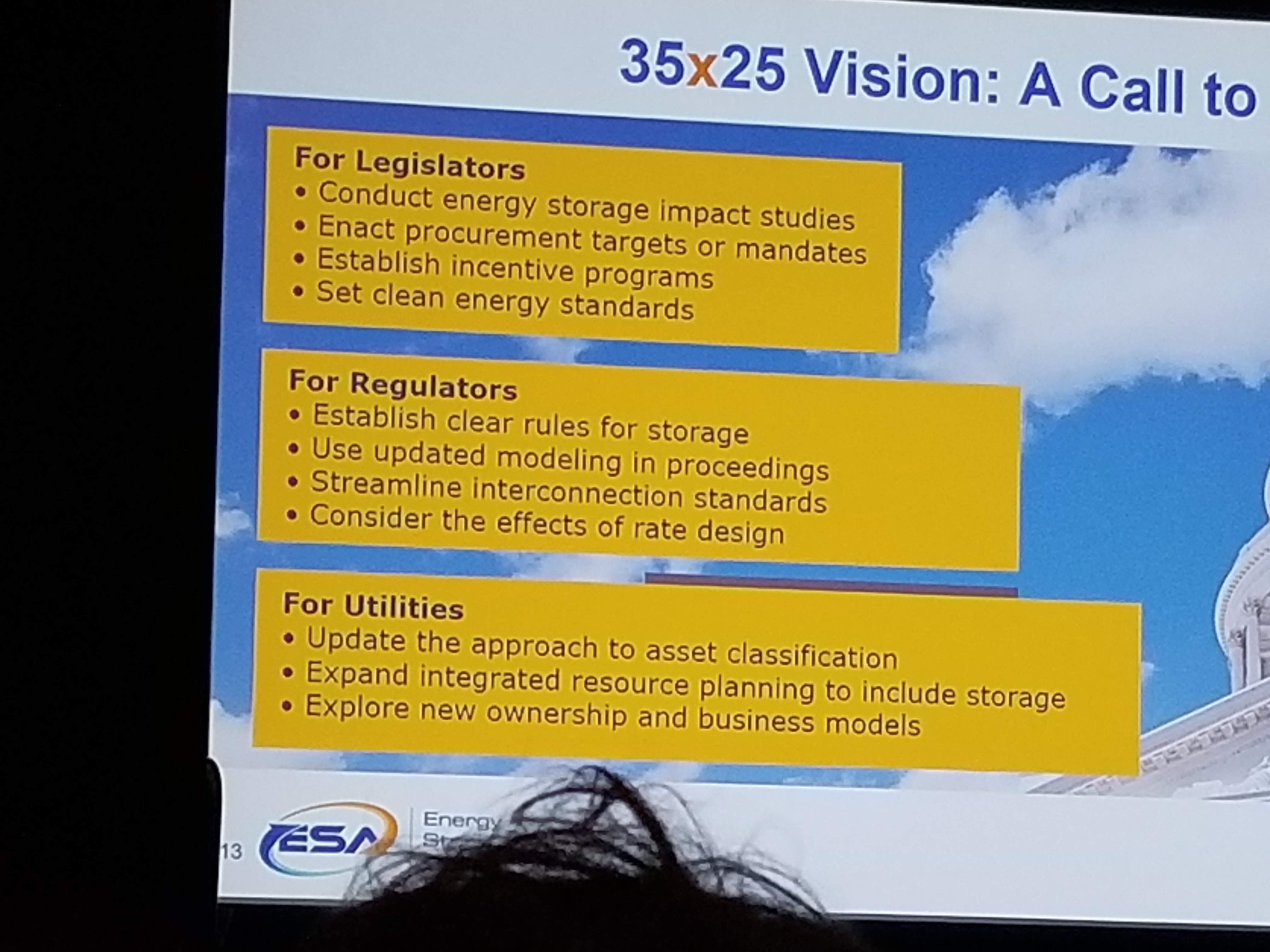 This is a great roadmap on how to get the 35 GW of storage by 2025, courtesy of Kelly Speakes-Backman, the CEO of the Energy Storage Association.[/caption]
By Frank Andorka, Senior Correspondent
By Frank Andorka, Senior Correspondent
One of the many things I learned from a former colleague of mine (he knows who he is) is the importance of baseload power. Or, as he would say, the absolute non-importance of baseload power. Basically, distributed resources like solar and wind make traditional electricity producers crazy. So crazy, in fact, that they say things like, "What happens if the sun isn't shining or the wind isn't blowing? We need baseload power supplies so we can keep the lights on 24/7." To which Angelina M. Galiteva, founder and board chair of Renewables 100 Policy Institute, an organization dedicated to accelerating the global transition to 100% renewable energy, says, "Baloney." (A sentiment with which my former colleague and I agree.)