

Breaking Down The Top Data from GTM Solar Summit 2015

By Yann Brandt

solar ppa pricingGreentech Media’s Solar Summit 2015 (#GTMSS2015) brought together over 500 of solar’s brightest. The solar summit tends to be a bit different than many other conferences since the focus is on data and research, rather than products and services. The event kicked off with Shayle Kann of Greentech Media, who broke down the current state of the solar market and with some sharp analyses. For the full coverage on the presentation, see here.

  1. Utility Scale Solar Costs Decline and Offtakers Base Grows

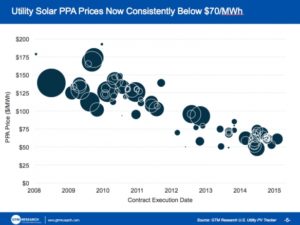
Utility scale solar is now consistently below $70/MWh and is being installed around the world at rates that match this new price, which shows signs of exponential growth. Now, to create new markets, we need a stable offtake environment and the lowest prices possible. There is cost to risk, so a 30-year merchant solar plant would likely average rates higher than $70/MWh. On the other hand, there is value for a hedge, which solar energy provides to utilities.

How does this affect the solar market?

With these lowered prices plus community solar, virtual net-metering, and direct access to customers who want solar, solar developers can sell the energy directly to users. Just look at the 130MW project for Apple — all of that energy is purchased by Apple but produced by a single, massive solar farm.

  1.  Residential Solar Market Gets Saturated

While there are 113 million households in America, it seems only 9 million can actually receive solar cost effectively. First, you start by removing the homes that are rented. Then, you narrow to homes in states that support solar and homes with sunny enough roofs. After, you need people with the proper FICO score. The total number of viable homes goes down 90%, leaving just 9 million homes. One interesting reduction is the 38 million homes in solar friendly states to 29 million homes that have the right FICO score.

How does this relate to other solar markets?

Imagine doing the same analysis in commercial solar. Going from all commercial buildings to commercial buildings in solar friendly markets is an easy analysis and in some markets represents almost 50% of total energy usage. For hypothetical purposes, let’s assume that the same is true for commercial and 33% of buildings are in solar friendly states.

Looking at the prior cutoff, does the tenant own their building? Probably a lower number than the residential comparison, but looking at the next question of “how many tenants/building owners have a FICO of over 680?”

That is the question of the day in my mind. How do you index the commercial solar credit outside of publicly traded customers? Yes, you can look at three years of financial statements, but how can you do that quickly and cost effectively?

  1.     The bundles energy market is here, going to get bigger, and more utilities are getting involved

We have already seen utilities get into non-regulated solar development and owning solar assets in their portfolio. Innovation, on the regulated side of utility headquarters, is becoming more prevalent. Florida’s investor-owned utilities have brought this up to the tune of nearly 1GW, and other states have already seen their regulators make decisions on this new era of energy system. On the other hand, things are also getting smaller like partnerships with EV charging stations, demand response systems, or home automation.

Does solar really benefit from this?

More solar is always a good thing for the sector, it means more jobs, more manufacturing, and more competition that drives the cost of capital down. Equally important, we can put resources toward the customer experience when we know there are plenty.

In the past it was a challenge to bring the rooftop industry down to eye level by doing a monitoring setup or something similar. Today, the ability of a bundled package increases the touchpoint between solar generation and the customer, which will make many more users become solar evangelists.

Being at Greentech Media’s Solar Summit was another great learning experience. Speaking on the crowdsourcing panel, I was, as usual, surprised by the general consensus of the industry. So while it always seems like I am a contrarian, I saw it more like an opportunity to have my thoughts challenged. The next events for me are Intersolar, Solar Securitization, and REFF Wall Street. I look forward to meeting you there.

Originally Posted on Conergy.com

Solar Asset Management: 4 Best Practices From The Experts

By Richard Matsui

mainpic-solarWith the notable exception of Intersolar North America, it’s surprisingly rare for a major solar conference to be held here in San Francisco. So when Solarplaza extended an invitation for us to speak at its 2nd annual Solar Asset Management conference here in the city, we leapt at the opportunity.

I joined fellow panelists Kent Williams (VP of Asset Management, Vivint Solar), Jimmy Bergeron (Director of O&M, SolarCity), and Matt Golden (Senior Consultant, IBTS) for a discussion entitled, “Challenges in effective management of small scale portfolios.”

4 Asset Management Best Practices From The Experts

Measure twice, cut once: With small scale portfolios, it is especially important to build systems right the first time. Why? The cost of a single truck roll to solve an O&M issue can wipe out years of electricity value that the system is generating. Therefore, the most cost-effective solution to O&M is to ensure that O&M is not needed in the first place, by ensuring your installers are building high-quality systems with high-quality equipment from the start.

You need to examine the tails: While our industry often describes portfolio performance in terms of its average (e.g. “my portfolio is at 103% of expectations), there is a wealth of insight hiding in the anomalies, the “tails”–especially when looking at portfolios that run into the hundreds or thousands of systems. Even with a “103%” portfolio, it’s your customers on the left tail of the portfolio distribution who are not giving you referrals and leaving you negative Yelp reviews.

Be disciplined with data collection: Jimmy Bergeron showed an impressive chart of 75+ O&M issues that SolarCity deals with, in order of frequency. Generating this chart requires that SolarCity classify every single O&M case it has ever handled–that is a painstaking investment for any developer. But it pays off richly: SolarCity has tremendous insight into what factors cause O&M problems. That insight is fed into the organization’s operations as learning, thus completing a feedback loop–which brings us to our last best practice.

Adopt a learning mentality: Even as our industry scrambles to service solar portfolios that are doubling in size every year, it is critical for asset managers to see the forest through the trees. After the session, one asset manager drew an analogy to medicine: “Today, a lot of O&M issue handling is really about treating symptoms, but we are not yet curing the underlying disease. In order to cure the disease, we must learn about what these symptoms share in common.” For instance, beyond simply fixing problematic systems as they arise, identifying underlying trends to learn that Installer X is systematically causing these problems will enable you to take corrective action up front.

kWh Analytics is helping our industry to “cure the disease.” We enable solar investors and asset managers to take control of their risk management and reporting through a web-based portfolio management platform. The platform delivers risk insights from 40,000+ PV systems, representing the industry’s largest independent database of operating solar assets. The firm’s clients include several of the leading solar originators and financial institutions.

Solar Going Mainstream? 5 Projections for 2015

By Jason Kaminsky

Now that 2014 has come to an end and we’ve seen a preview of what 2015 has in store, we felt it was the right time to put together our projections for the year. We look forward to picking this back up in 2016 and seeing how many of these actually materialized over the course of the year.

  1. Utility rates will be restructured – impacting existing solar users: 

While states like Hawaii are proposing modifications to their NEM rate structures for new customers only, proposals in California and Arizona are establishing a precedent that rate design can impact existing owners of residential solar PV systems. California’s IOUs are proposing to the CPUC a fixed-charge to help cover the fixed cost of providing service, as well as a reduction from 4 tiers to 2 tiers, with a lower kilowatt-hour rate for large electricity consumers. Arizona utilities are proposing large fixed charges (estimated to be $50 / mo for the average solar user), with a grandfather clause of only 10 years for existing customers – even those currently in a 20 year lease. We expect that at least one of these states will pass rate reform in a way that does not fully protect existing solar users.

  1. Customer focus on savings:

Technical discussions about rate design and NEM will spill into the mainstream media, leading consumers to re-evaluate their contracts. An easy consumer-facing tool to will enter the market (AmISavingMoneyOnMySolar.com is still available, folks!) and some consumers will be surprised to discover that savings did not match expectations. System performance issues that had previously gone unnoticed will also receive greater attention. Selective default risk will increase.

  1. Predictive scorecarding will begin to develop:

Almost the entire solar industry underwrites to FICO scores, but there are many other contributing factors that one would logically conclude may lead to payment disruption- consumer savings chief among them. To understand homeowner satisfaction, one needs insight into both a) system performance and b) contract structure, including initial rate and annual escalator. Solar developers will increasingly see the importance of being able to integrate their electricity production and payment performance databases for the purpose of predictive analytics and will use these tools to improve asset management of existing portfolios, to inform underwriting standards, or to analyze refinancings (via securitization, warehouses, asset sales to YieldCos, etc.).

    4.  Investor focus on performance:

In tandem, investors will increasingly focus on customer experience over the life of the transaction in their underwriting of residential solar portfolios. We see solar portfolios of thousands of systems operating in a range akin to a “peaky” normal curve, and investors will closely monitor the tails of actual energy production and expected homeowner savings relative to baseline expectations. Additionally, investors will push the origination community to use increasingly conservative rate escalators in their consumer contracts.

    5.  Industry benchmarking will become standard:

In fragmented industries that have access to liquid capital markets, firms exist that provide industry benchmarking and analytics services. Corelogic does this service in residential mortgages, Measure One in student loans, Trepp in commercial mortgages, etc. We believe that new investors will seek out industry data to support their underwriting, and existing investors will benchmark their portfolios to industry standards to evaluate performance. The trend toward a more mature asset class, where the data is used to establish industry trends and open the capital markets vs. being siloed throughout the industry, will continue.

2015 will be a period of continued growth in the industry – Lyndon Rive has gone on record that every major provider should plan for 100% growth this year. As a result, many companies will be in a position of quickly scaling their origination pipeline using their existing software systems, while needing to adapt in order to support the needs of more sophisticated underwriting and to satisfy the demands of investors. This push for scalability will continue the need for software solutions focused on data management, data analytics, and independent industry benchmarking.

About the author: Jason Kaminsky is the Vice President of Partnerships at kWh Analytics. Founded in 2012, kWh Analytics enables solar investors and originators to take control of their risk management and asset reporting through a web-based portfolio management platform. The platform delivers risk insights and industry benchmarks from 40,000+ PV systems, integrated with an industry-leading analytics platform. The firm’s clients include several of the leading solar originators and financial institutions. http://www.kwhanalytics.com/

Solar Investment Executives, what your New Year’s resolution should be!

By Haresh Patel

The next two years will be a bonanza for US solar investors aiming to capitalize on the 30% Investment Tax Credit. If you haven’t made your business New Years resolution here’s a recommendation.

10X your investments and grab market-share with the remaining 30% tax credit while also preparing for the hangover in 2017.

To achieve this goal, hiring alone is insufficient. There isn’t enough time or qualified people to hire. The executives that invest in tools and business processes to boost organizational productivity will dominate project acquisitions and, more importantly, maintain a lean cost structure that will be a must in 2017.

Time is of the essence

2 years may seem like a long time, but examining key investment milestones illustrates that solar investors only have a brief window to expand deal-flow before the ITC deadline.

Looking back to the 2011 expiration of the 1603 Treasury Grant we see that the real cutoff for solar investors actually came when banks stopped looking at projects, which hit about six months before the incentive expired. Therefore, while Dec 31, 2016 marks the COD deadline for the ITC, in order to syndicate financing, investors need all the critical elements of projects lined up by June 30, 2016. Performing diligence on the bare minimum aspects a project before it can be brought to a bank – conditional use permits, the off-take and interconnection agreements etc. – can take a month alone. Investors that need to bring in construction lenders or tax equity investors need even more time. This pushes back the time investors have to fill their deal pipelines even further, by a minimum of 1-2 months (April-May 30, 2016).

Second, the 2011 Treasury Grant expiration demonstrated that there will be severe financing bottlenecks as June 30, 2016 approaches. Banks will be inundated with so many potential projects it will give them the opportunity to pick and choose with discretion. Projects submitted later will face stiffer competition.

Hiring alone won’t solve your problem:

Solar investors that want to scale deal-flow by 10x, in time, solely by hiring more bodies should have done so yesterday. According to a study on hiring processes conducted by University of Chicago economists, filling vacancies in today’s economy takes between 5-12 weeks on average, depending on the size of the company. In the solar industry the available resource pool of high quality talent is small and competition is high. The next best option is to hire from outside the industry and train new employees, which adds another 6 months before they make a real impact. Meaning that onboarding a new group that is capable of boosting deal flow of a significant magnitude is not going to impact business until sometime between July-October 2015, at the earliest.

Putting it all together, a new team essentially has 7-10 months to fill a deal pipeline with 10x more viable projects.

This brief window emphasizes the need to maximize productivity. Investors need to invest in tools and processes that allow them to enhance origination and close deals quickly. Scaling a team by only adding bodies does not ensure success, the key to increasing deal-flow is maximizing the returns on the resources available.

Looking beyond the ITC

Solar investors that have had the foresight to begin scaling without addressing productivity may have limited success with top line growth, but they jeopardize their bottom lines. This will have severe consequences in 2017, when there will be an abrupt slowdown of investment opportunities. Companies with high cost structures will have an extremely difficult time achieving profitability. To compensate for shrinking incentives, solar investors need to learn how to consistently close more MW’s per employee. Implementing business processes that increase productivity today will insure a competitive business beyond the ITC.

Ultimately, solar investment is an execution play and the industry is maturing, which leaves a lot of room for business model improvements. Historical examples of successful execution oriented businesses demonstrate that winners often have the lowest cost structure. Dell Computer sold directly to customers to bypass middlemen, Amazon leveraged technology to keep a lean inventory and generate float, and Walmart is famous for extremely frugal corporate spending and, consequently, aggressive pricing to gain market-share. In solar, access to low cost of capital and a low cost structure will determine the winners. The industry is waiting for the companies with the best business model to emerge and dominate.

Haresh Patel is the CEO and co-founder of Mercatus Inc., a provider of cloud-based software solutions that simplify renewable energy investment.