
Nice Headline, Doctor – But That Doesn’t Make It True

By Frank Andorka, Senior Correspondent

What Happened:Ah, ya gotta love drive-by hit pieces led by tricky, click-bait headlines, don’t you (you don’t, and you SHOULDN’T)?

  • Vox ran an article (which you no doubt saw, given how many of you clicked on it) that implied somehow battery storage was bad for the electrical grid, headlined “Batteries have a dirty secret.”
  • Then, in the subhead, David Roberts, aka “Dr. Vox,” asserts that the actual deployment of batteries increases carbon emissions.
  • OMG, if true, right? Well, as you probably have already guessed, that’s not what the story says at all. Quelle surprise.
  • battery storage

    SolarWakeup’s View:  There are times when I kinda hate my profession. And articles like that by David Roberts, who implies he’s a doctor on Twitter (and may well be), this morning in Vox are some of those times.

    Under a headline “Batteries have a dirty secret,” Roberts implies that somehow, battery storage is bad for the environment. I’m sure he knows better, but he’s hoping you won’t (and there are a lot of average Americans out there who won’t).

    [wds id=”3″]

    Of course, once he’s got you sucked in by the click-bait headline, he can say whatever he wants. And what he wants to tell you is that in a fossil-fuel based electricity-generation system, battery storage can increase carbon emissions because the energy they’re storing is from fossil-fuel based electricity generation.

    Oh. Is this really…debatable? Is this…an argument we have to have? Isn’t it a pretty well-accepted maxim that if you put garbage in, you are going to get garbage out? (Yes. Yes it is.)

    He bases his entire premise on a study of current battery storage installations, which does find that to an extent – in places where solar and other renewables aren’t prevalent – battery storage stores energy from dirty fuel plants and therefore doesn’t do anything to cut back on fossil fuels and, in some cases, increases them.

    But to make the argument that battery storage is dirty (a premise, I should note, Roberts himself debunks in the article with a wink and a nod as if to say, “See what I did there?” Yeah, I see you, David, and I thumb my nose in your general direction), you have to accept another idea: Electricity generation is forever preserved in amber as it is today. In other words, we will never have enough renewables on the grid to change the unvirtuous cycle he describes.

    Which is, of course, nonsense at its core.

    I’m not going to lie: Toward the end of the article, Roberts makes some good points about how battery-storage policy needs to change and actually offers some useful ideas. Most people, however, won’t read past the headline, subhead and maybe the first three paragraphs. And if they do that in this piece, then they’re going to walk away thinking battery storage is bad for the environment – a false narrative that could hurt the industry in the long run.

    More:

    Dave Roberts Lies About A Thing To Get You To Click On A Story (But I’m Not Going To Enable Him)
    Turns Out, Silvio Marcacci May Be On To Something (About 320 GW Of Untapped Solar Potential)

    By Frank Andorka, Senior Correspondent

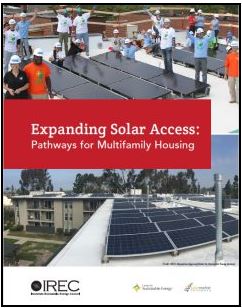
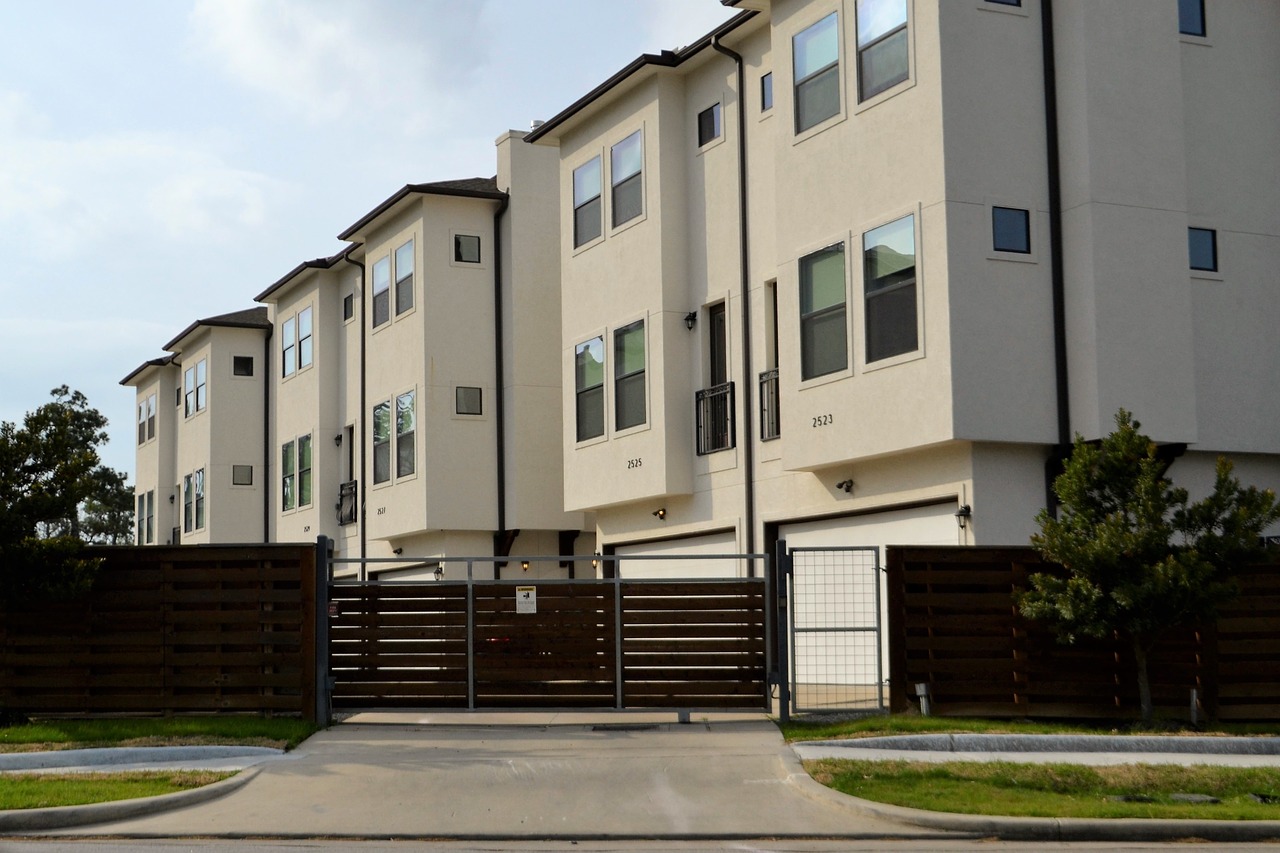
    What Happened:The Interstate Renewable Energy Council has released a report outlining two potential paths to enable greater solar access for renters and multifamily residents, and low-to-moderate income communities.

  • The report, titled Expanding Solar Access: Pathways for Multifamily Housing, suggests shared solar, whether on-site or off-site, is the key.
  • Following on last week’s Forbes magazine article by Silvio Marcacci arguing that there could be 320 GW of untapped solar potential in just these types of applications, the report seems timely.
  • IREC

    A new IREC report reveals new paths for renters and multifamily dwellings to add solar to their electricity production.

    SolarWakeup’s View:  Last week, I gave major props to solar support Silvio Marcacci’s article in Forbes magazine that discussed there might be 320 GW of untapped solar potential on non-traditional solar applications, including multifamily and other commercial properties. Then the Interstate Renewable Energy Council (IREC) published a report called Expanding Solar Access: Pathways for Multifamily Housing, which offers two pathways to reach Marcacci’s proposed goal.

    I’m sensing a pattern.

    [wds id=”3″]

    Unsurprisingly, the key to adding solar to multifamily housing is shared solar or, as it is more commonly referred to within the industry, community solar.

    “Shared solar programs can enable multiple customers, including renters in multifamily housing, to share the economic benefits of a single solar power system and to receive credits on their utility bills for the electricity generated by that common system,” explains IREC Regulatory Program Director Sara Baldwin Auck. “Given the large percentage of renters nationwide, policymakers need to ensure that policies and programs allow them to take advantage of the benefits of solar and other related clean energy technologies, such as energy storage and energy efficiency,” says Auck.

    Also unsuprising is the fact that the Bullitt Foundation says low-income households are disproportionately affected by the rising cost of energy, paying up to four-times the proportion of income on energy costs relative to their higher-income peers. So to make solar the truly revolutionary electricity generation form everyone expects it to be, you have to find ways to give non-traditional solar users access.

    The new IREC report points in the right direction. Take a look.

    More:

    Expanding Solar Access: Pathways for Multifamily Housing

    Forbes Article Reveals 320 GW Of Untapped Solar Potential

    MPSC Issues Most Unsurprising Ruling Ever (And Approves $1 Billion DTE Energy Plant)

    By Frank Andorka, Senior Correspondent

    What Happened:The Michigan Public Service Commission (MPSC), in a decision that surprised no one, awarded DTE Energy the right to build its $1 billion boondoggle natural gas plant.

  • The commission appears to have ignored, you know, the evidence that showed renewable energy – specifically solar – would provide a much better bang for ratepayers’ bucks than this natural gas plant.
  • The action comes as a blow to solar advocates across the country, who were watching this case to see if the aggressive tactics would stop the plant.
  • Proposed natural gas plants are increasingly being denied in various states as unnecessary, particularly in solar-friendly states like California and Arizona. But the DTE Energy plant is a victory utilities desperately needed to keep putting these monstrous proposals forward.
  • MPSC

    Proof that, given the choice, public utilities commissions will protecct the utilities’ right to do whatever they want, even in the light of evidence.

    SolarWakeup’s View:  That was as predictable a 4-win season for the Cleveland Browns, wasn’t it? Despite strong, well-reasoned and evidence-supported opposition, the Michigan Public Service Commission (MPSC) decided to cave to DTE Energy’s desire to build a $1 billion natural gas plant instead of investing in renewable energy technologies, which evidence from critics of the plant prove would have been a better investment for everyone involved.

    [wds id=”3″]

    This is the second crushing blow to the state’s solar industry within a week after the MPSC replaced net metering – the most effective pro-solar policy ever invented – with an inflow/outflow system that penalizes solar users and eliminates retail net metering.

    In particular, Vote Solar, which had led the opposition to the plant in a striking departure from their usual strategies of intervening solely in solar cases, expressed disappointment in the decision.

    “This is a rotten deal for customers and terrible precedent for utility planning in Michigan,” said Becky Stanfield, senior director of Western States for Vote Solar. Stanfield oversaw the Michigan fight for the group. “Everyone in this case knows that there is a better way for DTE customers than this expensive, inflexible and polluting plant. The record was solid against approval.”

    The Solar Energy Industries Association (SEIA) also weighed in – and they weren’t happy, either.

    “We are extremely disappointed with the Michigan Public Service Commission’s decision in this case,” said Sean Gallagher, vice president of state affairs for SEIA. “Despite the overwhelming evidence that DTE failed to adequately consider alternatives, including a portfolio of renewable energy solutions that would lead to greater savings, more jobs, reduced risk, and environmental benefits, the Commission authorized a $1 billion plant that would not pass muster with Michigan’s laws if it were proposed today.”

    I gotta throw in with Becky and Sean. This decision doesn’t make any sense on any level and deals a significant blow to chances of building a robust solar industry in the state. Meanwhile, Illinois and Minnesota get to keep their lead in Midwest solar development. It’s perplexing, though it’s not surprising.

    As more consumers are finding as these battles play out across the country, most public utilities commissions are naturally inclined to support utilities over consumers and, although that is changing, it’s not changing fast enough, as today’s decision in Michigan shows.

    More:

    Michigan Utility Under Fire For Alleged PURPA Violations

    Decision On Fate Of $1 Billion DTE Natural Gas Plant Looms

    Coalition Delivers 10,000 Michigander Letters Calling on DTE to Drop Its Gas Plan and Choose Clean Energy (Vote Solar)

    Power Up Michigan

    Michigan Public Service Commission

    Bonus:

    “I’m shocked, SHOCKED…..”

    Hawaii Revolutionizes Consumer-Utility Relationship With New Law

    By Frank Andorka, Senior Correspondent

    What Happened: Hawaii has rebalanced the relationship between utilities and their customers with a new law tying rate increases to performance data.

  • According to Hawaii Public Radio, “The Hawaii Ratepayer Protection Act will require the Public Utilities Commission, the PUC, to develop incentives for local electric companies to modernize and manage costs.’
  • The law takes effect July 1st. The PUC will then be required to create an incentive framework by January 1, 2020.
  • Hawaii

    SolarWakeup’s View:  To call Hawaii’s solar situation “complicated” would be like calling World War II a “kefuffle.” Ever since October 2015, when the PUC eliminated net metering precipitously (in the minds of many), the solar industry has struggled to re-find its identity. Hell, things in Hawaii were so bad that last year, the president of the Hawaii Solar Energy Association told an audience at Intersolar North America:

    ”I think people working in solar in Hawaii have reached the fifth stage of grief – acceptance – as many of us are looking at the impending death, for all intents and purposes, of the solar industry in the state,” he added.

    He also added that a painful (he called it “nasty, brutish and long”) transition from net-metering to three stopgap programs that have slowed residential installations to a crawl.

    [wds id=”3″]

    A law signed by Governor Daniel Ige, however, called the Hawaii Ratepayer Protection Act, could restart the business – at least that’s the hope of residential companies already heavily invested in the solar industry like Sunrun (emphasis added).

    “Other state Legislatures and Commissions should take notice of Hawaii’s efforts,” said Anne Hoskins, chief policy officer of Sunrun. “The time to make these changes is now, before billions of dollars are spent in rebuilding our outdated electrical networks. Rooftop solar and home batteries are allowing users to choose a system that maximizes public benefits, not utility shareholder profits. Let’s keep giving people the freedom to create a brighter future.”

    Any legislation that can help alleviate the mindless fighting between utilities and solar users is music to my ears. Let’s hope this new law can help the Aloha State return to its place as a leading residential solar state (and may this law, if it works, become a model for the rest of the country).

    More:

    Electricity Ratepayer Protection Act Signed Into Law (audio included) (HPR)