

Connecticut Catastrophe, Part 3: Ugly? Solar Is NOT Ugly – But The Battle In The CT Legislature Is

By Frank Andorka, Senior Correspondent

What Happened: The Connecticut Senate voted on the horrifically anti-solar SB 9 yesterday and passed it. It now moves on to the House today, with a vote scheduled for tomorrow.
  • This is our last chance to stop this monstrosity, so get on your phones TODAY and call a Connecticut House member to urge them to vote against this bill.
  • But let’s focus today on the blatant hypocrisy of Democratic Rep. Lonnie Reed, who had no problem taking solar’s shine when it suited her, but called solar “ugly” during yesterday’s debate.
  • Part 3

    SolarWakeup’s View:  Here’s Part 3 of our ongoing series on “The Connecticut Catastrophe.”

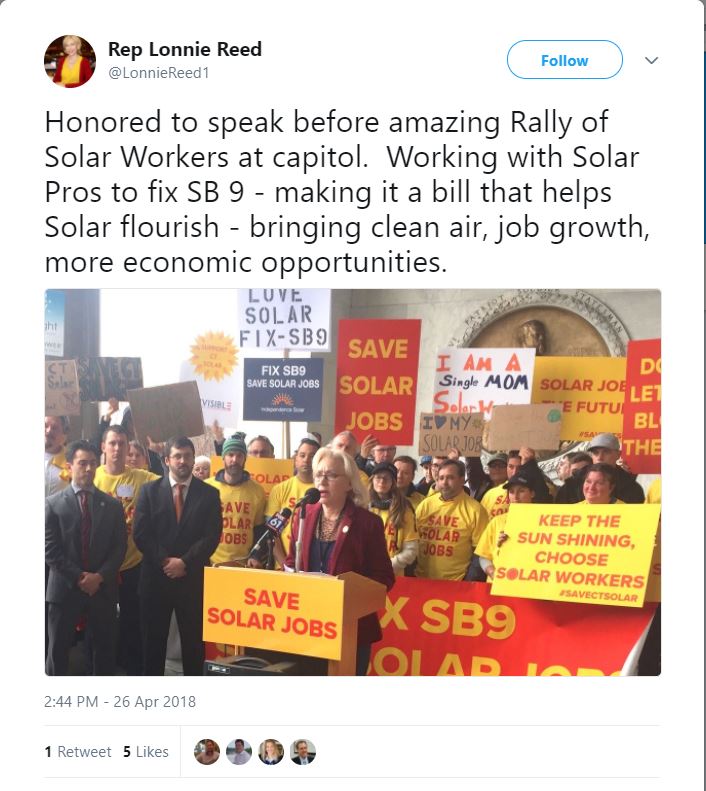
    See that tweet up there? That is Democratic Representative Lonnie Reed, back when she supported the solar industry on April 26.

    “Honored to speak before amazing Rally of Solar Workers at capitol,” Rep. Reed said way back two weeks ago. “Working with Solar Pros to fix SB 9 – making it a bill that helps Solar flourish – bringing clean air, job growth, more economic opportunities.”

    Someone should have reminded her that the Internet is forever before she went on to trash the industry ahead of today’s House debate on the bill, one in which she will play a vital role or, as we like to call it, Part 3.

    [wds id=”3″]

    I’m going to quote extensively from the CT News Junkie because Reed’s words are breathtaking in their hypocrisy:

    Rep. Lonnie Reed, D-Branford, who watched the debate and co-chairs the Energy and Technology Committee with Winfield, said the solar industry is exaggerating the changes the bill makes.

    Reed said net metering is back in the bill, which would allow homeowners to sell any unused portion of the energy they generate back to the grid.

    “We protected net metering,” she said. “Otherwise why would you do it? I mean they’re ugly.”

    She said some of the smaller solar installers are nervous because “it’s different and they can’t stand change.”

    I’ll give you a minute to let that reductive, smug garbage sink in to your veins for a moment. So this woman who was supposedly “honored” to speak before a rally of solar workers two weeks ago now thinks solar modules are “ugly” and that solar installers are just being sore losers who “can’t stand change.”

    As the solar industry takes the knife out of its back, I’d like to say something to Rep. Reed: I hope all that sweet utility cash, or cushy post-political job, or whatever the utilities/fossil-fuel interests paid for your vote is really worth compromising any principles you might have claimed. I mean, Sweet Mother of God, it’s only been two weeks, for crying out loud.

    OK, so now that the sting of her words is subsiding, get out your phones and make the calls. Here is a list of all the Connecticut representatives voting on this tomorrow.

    Go make some calls – the future of Connecticut solar is at stake. Only we can stop Part 3 from being the unseemly end of solar in Connecticut.

    UPDATE: Our friends at Sunrun also have a link that allows you to take action. Please do it now.

    More:

    Energy Bill Heads To House, Solar Installers Object

    Connecticut Catastrophe, Part 2: Solar Consumers Are NOT Utilities

    How To Screw Up Solar With One Horrid Bill (Connecticut Edition)

    Net Metering Is NOT A Subsidy, No Matter How Loudly Duke Energy Says It

    By Frank Andorka, Senior Correspondent

    What Happened: Duke Energy penned an opinion piece for The State boldly arguing the cost-shift, which I have to admit is a gutsy move.

  • It’s particularly gutsy since, as I’ve written so many times my fingers can type it without any guidance from my brain, THE COST SHIFT ARGUMENT IS A LIE.
  • To make my life easier later in this piece, I’ll just note here that the Solar Energy Industry Association (SEIA) says South Carolina receives 0.21% of its electricity from solar sources, a fact that, as always, is essential when trying to kill the zombie lie of the cost shift.
  • Duke Energy

    Only the South Carolina legislature stands between Duke Energy’s zombie “cost-shift” lie and its solar consumers.

    SolarWakeup’s View:  The entire opinion pieced penned by Kodwo Ghartey-Tagoe, president of Duke Energy South Carolina, is a brazenly brilliant piece of anti-solar propaganda wrapped up in a concern-troll blanket and foisted on the poor readers of The State, South Carolina’s statewide newspaper. It is one of the first times I’ve seen a utility executive himself go on record banging the drum for the zombie lie of the cost shift.

    [wds id=”3″]

    As I have shouted into the abyss so many times I can’t even count them all, the cost-shift is complete nonsense. I should have this explanation as a macro so I don’t have to type it every time. Let’s review:

    The argument goes like this: Retail-rate net metering, a program under which solar customers are reimbursed for the excess electricity they produce, pushes extra costs on to non-solar customers because solar customers aren’t paying for grid upkeep.

    What the utilities don’t want you to notice, of course, is that solar customers also relieve congestion on the grid during peak production times, which saves strain on the transmission and distribution lines. So while they may not be paying for upkeep directly, solar production saves wear and tear, which ultimately saves the utility money in the form of repair costs.

    You’re welcome.

    I should note here that while there is a minor cost-shift, a study by the Lawrence Berkeley National Laboratory indicates the shift only happens when a state passes the 10% mark for solar-electricity generation. And I should also note that even at more than 10%, the shift is so small you’d need the Berkeley Lab’s $27 million electron microscope to see it.

    The entire idiotic thing is based on the (false) portrayal of net metering as a subsidy, which it is not. what net metering is is a free-market solution to the “problem” of solar array overproduction. In other words, if I produce a product, the utility should have to pay me fair market price (retail rate) for it. That’s the whole basis of capitalism, after all – Invisible Hand and all that (yeah, I’ve read Adam Smith).

    And the other thing Duke Energy doesn’t want you to notice is that they are a state-sponsored monopoly that receives actual subsidies guaranteed by the state, so…you know…that’s a thing that is happening, too.

    I’ll give Ghartey-Tagoe one thing: He’s not wrong when he says Duke Energy isn’t anti-solar. Turns out, they’re very much pro-solar – as long as they are the ones that are producing it.

    More:

    Why should the rest of us pay to subsidize people who choose rooftop solar power?

    South Carolina Tries, Tries Again To Reach Solar Compromise

    Are We Harping On South Carolina Net Metering? Yes, Because YOU Are

    Utility Monopolies Screw SC Solar After Sneaky Shift On Bill

    South Carolina Sends Solar Soaring With Cap Removal

    South Carolina Solar Soul Under Attack

    Could California Become The First State To Require Solar? Yes.

    By Frank Andorka, Senior Correspondent

    What Happened: California could become the first state to mandate all new-build homes be powered by solar energy.

  • The state’s energy commission (CEC) will vote this week on the proposal, which would require virtually all new-build residences to be outfitted with solar modules.
  • Reports say around 20% of new builds in California are currently solar-ready.
  • California

    SolarWakeup’s View:  The California Energy Commission could completely revolutionize what it means to go solar if they approve rules later this week that would mandate solar modules be included on all new-build homes three stories or higher.

    According to a report in The Independent, a British newspaper, the mandate is part of a push to make all new homes in the state “net-zero,” meaning they produce no emissions and produce the amount of energy they need. The rules also stress a shift away from natural gas and other fossil fuels to renewable-energy-produced electricity.

    [wds id=”3″]

    As with most things solar, California is moving to the cutting edge, apparently feeling that you can’t do great things piecemeal.

    The plan is not without opposition, including from builders who say the additional construction costs would add around $30,000 to your average California house and could put housing out of reach of more lower- and middle-class potential homeowners.

    But even the critics conceded that over the life of the system, homeowners would save $60,000, making the addition of a solar array to the home a net profitable addition.

    Honestly, I don’t know how I feel about this. As a pro-solar advocate, of course, I think it’s a great idea. It will certainly help a state solar industry that has been a bit buffeted by new time-of-use rates and federal tariffs. And as we all know, as California’s solar market goes, so goes the national market.

    On the other hand, affordable housing is a serious issue in California and beyond, and if mandated solar in California does push people out of the housing market, is it worth it?

    I’m torn and would love to hear your thoughts on the matter.

    More:

    California set to become first US state requiring solar panels on new homes

    SolarWakeup Podcast: Sunnova Makes Its Move Into Florida – Here’s Why

    By Frank Andorka, Senior Correspondent

    What Happened: It appears Florida is finally getting serious about becoming a viable solar market. Two weeks ago, the Public Service Commission decided, against all odds and the expectations of some seasoned solar observers, to allow third parties to own solar arrays without becoming regulated utilities.

    In the wake of the decision, at least one major residential solar company has decided to execute a Florida market plan it’s been working on for years and waiting for precisely the right moment to go in—and they’ve decided now is that time.

    To discuss this development is the the CEO of that company—Sunnova—John Berger.

    Join us on June 21st in Chicago for SolarWakeup Live! to talk about all things happening in Illinois. Stay tuned for tickets and more info.

    More: