

More Power To The Powerful: NextEra Buys Two More Florida Utilities For $6.5 Billion

By Frank Andorka, Senior Correspondent

NextEra Energy

In a deal that gives the owner of Florida Power & Light even more influence on electrical policy in the Sunshine State, NextEra Energy has entered into agreements to purchase two more Florida utilities for nearly $6.5 billion.

NextEra announced plans to purchase Gulf Power from Southeast utility giant Southern Company, as well as Florida City Gas. It will also purchase ownership interests in two natural gas plants currently owned by Southern.

[wds id=”3″]

The transactions will give the owner of Florida’s largest utility more incentive to push a natural gas – rather than a renewable – future for its customers.

“We look forward to updating the Florida Public Service Commission and other key stakeholders in the state and believe our deep operating expertise in Florida, strong financial profile and track record of and commitment to making smart, long-term capital investments offer uniquely compelling advantages for Gulf Power and Florida City Gas customers,” said Jim Robo, chairman and chief executive officer of NextEra Energy.

While the company’s press release extols NextEra Energy’s ownership of Florida Power & Light, which appears to have seen the solar light after spending millions of dollars on an ultimately unsuccessful attempt to inhibit the growth of rooftop solar in 2016, the purchases do enhance the possibility the company will slowly steer away from a solar future to a natural gas one.

It also provides a monopoly-like grip on Florida electricity customers, adding more power – literally and figuratively – to a company that already wields legendary power in Tallahassee.

The acquisitions of Gulf Power and the ownership interests in the Oleander and Stanton generating plants are subject to receipt of approval from the Federal Energy Regulatory Commission and the expiration or termination of the waiting period under the Hart-Scott-Rodino Act. The Florida City Gas acquisition is subject to the expiration or termination of the waiting period under the Hart-Scott-Rodino Act and is conditioned on the consummation of Southern Company’s previously announced dispositions of the Elizabethtown Gas and Elkton Gas divisions of Southern Company Gas.

It is unlikely that FERC or the Florida Public Service Commission will stand in the way of the acquisitions, particularly under the current administration in Washington.

Take The SolarWakeup Q2 Sentiment Survey (30 seconds)

By SolarWakeup Editorial

Results will be released at SolarWakeup Live! Chicago, on June 21st. The survey is 5 questions and only takes 30 seconds to complete. This is a personal sentiment survey so all SolarWakeup readers can participate. Given the ups and downs of the solar industry, we hope this will help us gauge the overall feelings in our industry.

Trump Tweet Commends “Clean Coal” Even As DTE Energy Continues To Shut Down Coal Plants

By Frank Andorka, Senior Correspondent

DTE Energy

Three months after announcing it would completely eliminate coal from its portfolio, Detroit-based utility DTE Energy announced on Friday it, along with partner Consumers Energy, was accelerating plans to increase its clean-energy portfolio to reach a generation target of at least 50% by 2030.

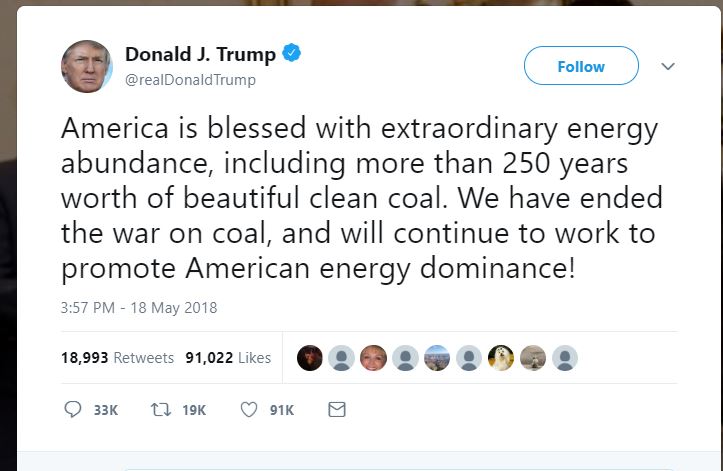
The utility’s announcement came on the same day President Donald J. Trump tweeted that the United States has 250 years of “clean coal” in its energy mix and touted the fact he ended the mythical “war on coal.”

DTE Energy’s announcement is further proof that the era of coal is rapidly coming to a close whether coal barons like failed Senate candidate Don Blakenship or President Trump want it or to or not, and no amount of regulation or edicts from the federal government will stop it from coming. For example, DTE said it would reach its goal by investing in a goal of at least 25% renewable energy reaching the remainder of its goal through energy efficiency programs.

“Our two companies [DTE and Consumers Energy] are overwhelmingly in favor of renewable energy and are focused on bringing additional energy efficiency opportunities to our customers,” said DTE Energy Chairman and CEO Gerry Anderson and Consumers Energy CEO Patti Poppe. “We will continue to work within the framework put forward by our legislature and regulators to build on our environmental initiatives to benefit all residents of the state.”

The decision to accelerate the clean-energy program is at least in part the result of an agreement with progressive billionaire Tom Steyer’s Clean Energy, Healthy Michigan (CEHM) group to place aside a ballot proposal to increase the state’s renewable portfolio standard. The group had gathered enough signatures to put an increase in the RPS on the ballot.

Details of the two companies’ plans to retire coal plants and increase wind and solar generation will be outlined in their respective Integrated Resource Plans.

Trump has routinely touted the benefits of “clean coal” without seeming to understand what that phrase means or that “clean coal” is really just coal, with all the requisite carbon emissions that would result from burning it.

New Marketing E-Book Targets Clean Energy Companies

By Frank Andorka, Senior Correspondent

e-book

Tigercomm, a marketing firm with numerous clients in clean energy, released an e-book titled How Clean Energy Companies Can Engage Customer Prospects Faster in an Attention-Scarce World, which it says is designed to help companies market themselves better.

As clean energy becomes more commoditized, the e-book argues it’s more difficult for one company to stand out from every other company. And with a finite number of legitimate customers, that can be frustrating.

“Across clean economy sectors, sales and marketing teams we talk to share a growing frustration: It’s gotten harder to get customer prospects to engage,” the authors say. “They’re all too familiar with sending that 7th “touch base” email to a prospect they’ve connected with at the trade show and hearing nothing back.”

[wds id=”3″]

The authors argue this experience has three major components, ones they call the “VAR Phenomenon”
(Volume, Attention, Relevance), which they define as the following

● Volume – Customers are exposed to an enormous volume of electronic content – which grows by 50% each year. Americans now spend roughly 10 hours a day in front of computers, smartphones, tablets and other devices.
● Attention – The sheer weight of all that content has drastically shortened attention spans, by at least 20% since the mobile revolution. According to a study by Microsoft, people now have an eight-second attention span, less than a goldfish, which can manage to focus on something for roughly nine seconds.
● Relevance – Shrinking attention spans mean that to attract a sales prospect’s attention, content must be relevant to their needs at the moment they recognize they have that need. The fact that someone searched for and selected a story or website is a strong indicator of relevance.

Once they’ve identified what they see as marketers’ top difficulty, the e-book explores numerous ways to capture that short attention span and target customers with the information about clean energy they need to make the decision to cal the companies in question.

To read the executive summary, click here.