

Solar Energy Industries Association (SEIA) President and CEO Abby Hopper responded to SolarWakeup's reporting on its courting of utilities to become members of the association in an email to its board of directors: Dear Board of Directors: Many of you have read this morning’s Solar Wakeup, which focused on our discussions about new means for working with utilities, and our deliberations on the ownership of Solar Power International (SPI).
Solar Energy Industries Association (SEIA) President and CEO Abby Hopper responded to SolarWakeup's reporting on its courting of utilities to become members of the association in an email to its board of directors: Dear Board of Directors: Many of you have read this morning’s Solar Wakeup, which focused on our discussions about new means for working with utilities, and our deliberations on the ownership of Solar Power International (SPI).
As to the SPI angle, in 2016, the board discussed options including buying SEPA out, selling to SEPA, or keeping things the same, and everything in between. After much consideration and consultation, we concluded that an extension of the existing relationship was the right business decision.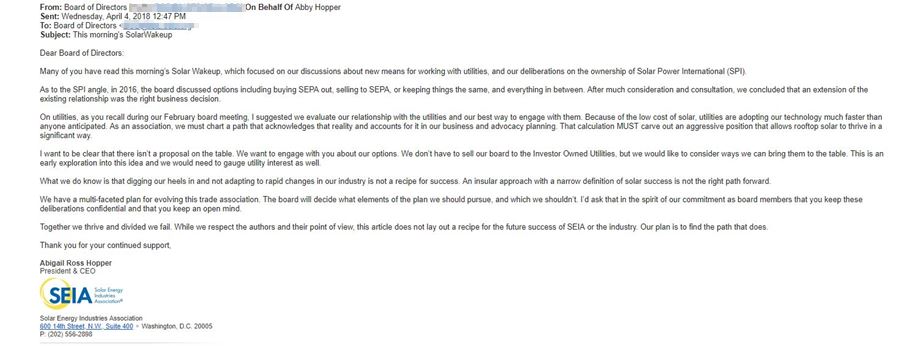
By Frank Andorka, Senior Correspondent What Happened:Yesterday, the Illinois Commerce Commission (ICC) approved the state's Long-Term Resources Procurement Plan (also known as "The Plan"), an overarching roadmap for the state to reach 25% renewable energy by 2025.
By Frank Andorka, Senior Correspondent What Happened:Yesterday, the Illinois Commerce Commission (ICC) approved the state's Long-Term Resources Procurement Plan (also known as "The Plan"), an overarching roadmap for the state to reach 25% renewable energy by 2025.
- The Long-Term Renewable Resources Procurement Plan arose out of the Future Energy Jobs Act of 2016.
- “With the approval of this ambitious plan, Illinois takes another step toward becoming a national leader in affordable clean energy. A more diverse power portfolio, which includes wind and solar, makes the grid more stable and affordable.
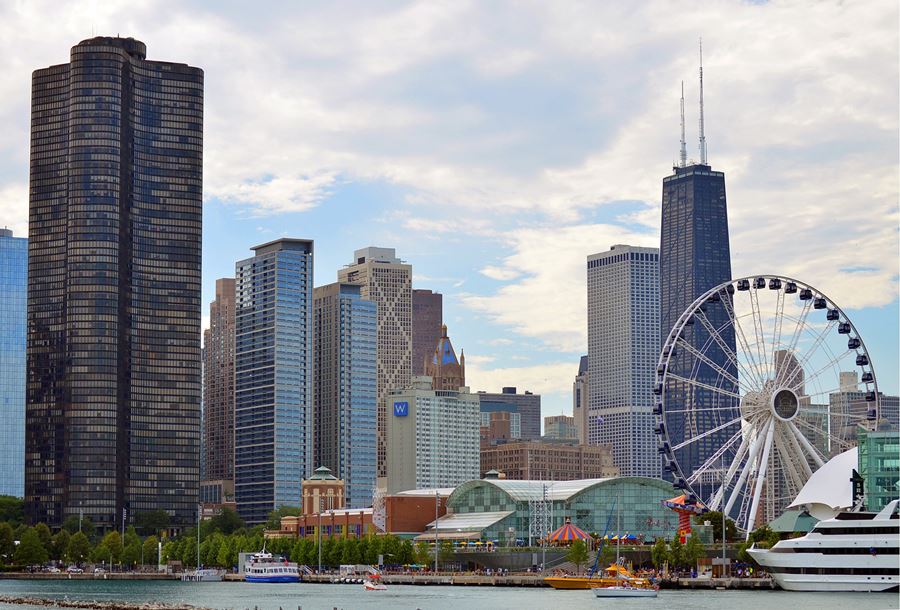 SolarWakeup’s View: Now that's what's called vision.
As expected, the Illinois Commerce Commission approved the Long-Term Renewable Resources Procurement Plan (the Plan), bringing to fruition the vision of Illinois lawmakers that began two years ago when the state's legislature, utilities and clean energy advocates pushed for the passage of the Future Energy Jobs Act.
What made the Illinois plan unusual was the widespread support it received across all segments of the energy economy in the state. While not unheard of (California's utility/legislature/renewable-energy partnership is a prime example), the Illinois plan is unusual, especially in the Midwest. Decisions like this bode well for the future of solar in the middle of the country.
SolarWakeup’s View: Now that's what's called vision.
As expected, the Illinois Commerce Commission approved the Long-Term Renewable Resources Procurement Plan (the Plan), bringing to fruition the vision of Illinois lawmakers that began two years ago when the state's legislature, utilities and clean energy advocates pushed for the passage of the Future Energy Jobs Act.
What made the Illinois plan unusual was the widespread support it received across all segments of the energy economy in the state. While not unheard of (California's utility/legislature/renewable-energy partnership is a prime example), the Illinois plan is unusual, especially in the Midwest. Decisions like this bode well for the future of solar in the middle of the country.
As the Midwest has moved - often glacially - toward its own solar future, most observers have pegged Minnesota as the early leader that has stood clearly head and shoulders above all the other states in the region. But I believe that as the Plan moves forward that it won't be long before Minnesota is looking over its shoulder to see Illinois quickly approaching.One of my favorite Illinois renewables observers, Christie Hicks, manager, Clean Energy Regulatory Implementation for the Environmental Defense Fund, said the following on the ICC's decision:
“Hundreds of millions of investment dollars will soon be flowing into developing clean wind and solar projects that will power Illinois homes and businesses. Not only is Illinois solidifying its place at the forefront of America’s clean energy economy, it’s showing other states how to provide equitable access to renewables.”We're pretty pumped about the approval here at SolarWakeup, too, because it will make our SolarWakeup Live! Chicago stop later this year even more intense. We plan on arriving in the Windy City when it's a little warmer (see this summer; We're coming to Chicago this summer) to break it this plan down for you and what it means for the future clean energy in the Land of Lincoln. We can't wait, so stay tuned - details coming soon. More: Illinois Is Coming For You, Minnesota [pdf-embedder url="http://www.solarwakeup.com/wp-content/uploads/2018/04/17-0838-Final-Order.pdf" title="17-0838 Final Order"]
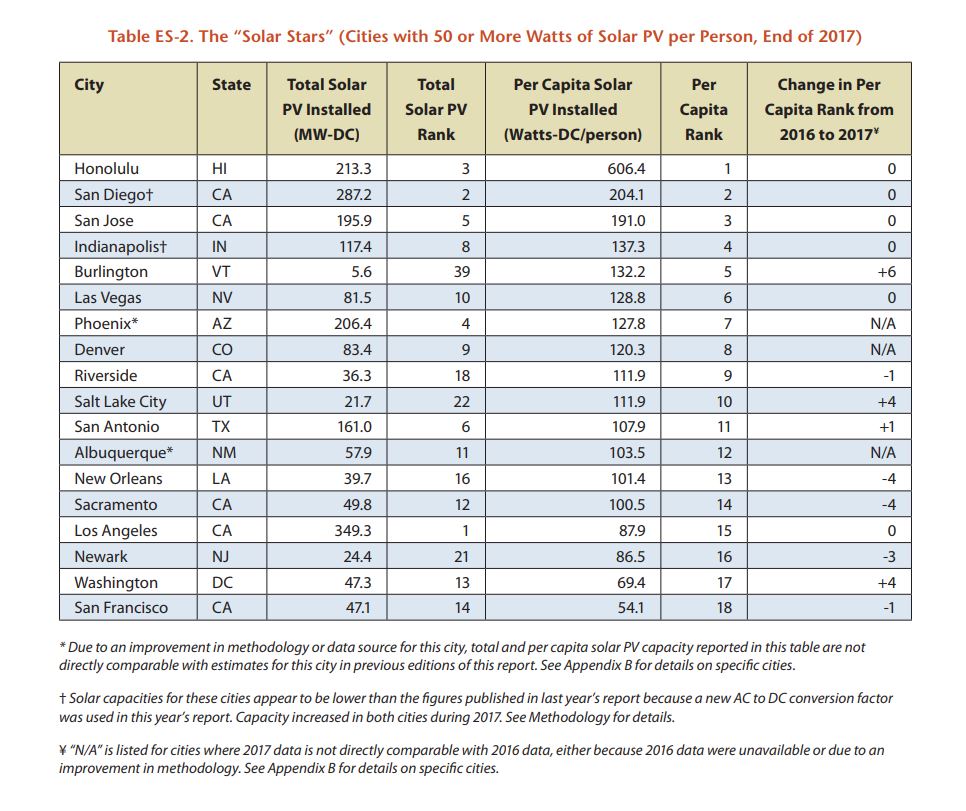
By Frank Andorka, Senior Correspondent What Happened: Environment America released its list of top cities for solar development, and Los Angeles tops the list, with San Diego, Honolulu, Phoenix and San Jose rounding up the Top 5.
By Frank Andorka, Senior Correspondent What Happened: Environment America released its list of top cities for solar development, and Los Angeles tops the list, with San Diego, Honolulu, Phoenix and San Jose rounding up the Top 5.
-
- The first "surprise" city on the list is San Antonio, which clocks in at No. 6. Other surprises include Indianapolis, which arrives at No. 8, and Albuquerque, which shows up just outside the Top 10 at No. 11.
- The list reads as a Who's Who of cities with smart leadership in the administration and, in many cases, well-run municipal utilities like LADWP.
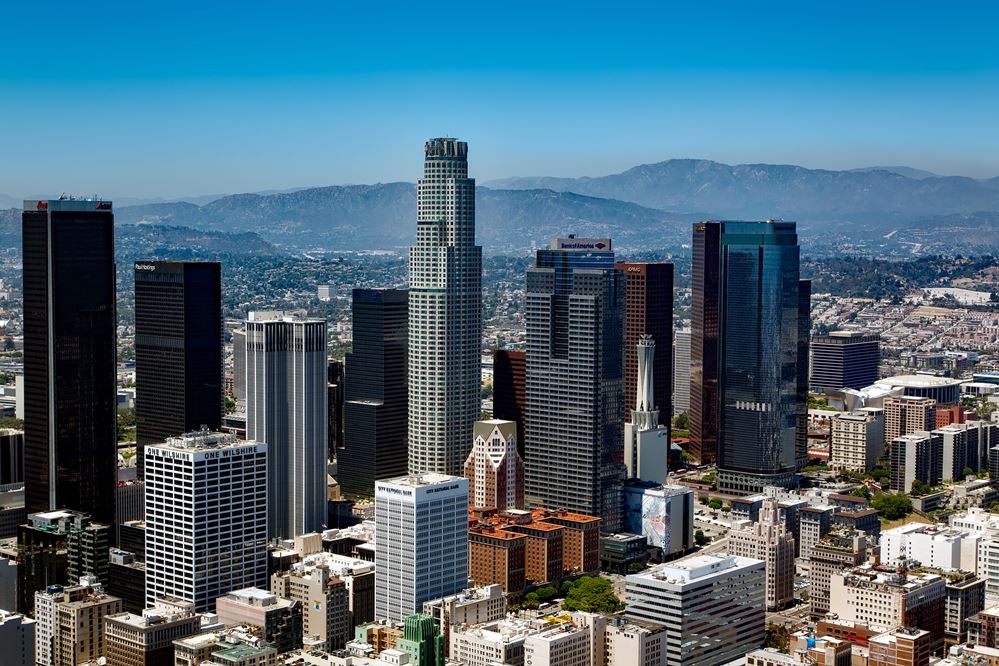 SolarWakeup’s View: I love lists like the one Environment America put out this morning concerning the country's top solar cities. The first thing I do when a list like this comes out is to see which cities surprise me.
On this list, the first one to catch my eye is Indianapolis, a city I used to drive through frequently when I was coming home from graduate school at Indiana University in Bloomington. While it's a nice enough city, I must admit I never would have considered it a hotbed for solar development. But it clocks in at No. 8 on Environment America's list, showing that the Solar Revolution is spreading across the country, even to the cloudy Midwest (as I sit here right now in Cleveland, there's overcast skies, with small breaks of sunshine and ... snow. Yep. Snow.)
SolarWakeup’s View: I love lists like the one Environment America put out this morning concerning the country's top solar cities. The first thing I do when a list like this comes out is to see which cities surprise me.
On this list, the first one to catch my eye is Indianapolis, a city I used to drive through frequently when I was coming home from graduate school at Indiana University in Bloomington. While it's a nice enough city, I must admit I never would have considered it a hotbed for solar development. But it clocks in at No. 8 on Environment America's list, showing that the Solar Revolution is spreading across the country, even to the cloudy Midwest (as I sit here right now in Cleveland, there's overcast skies, with small breaks of sunshine and ... snow. Yep. Snow.)
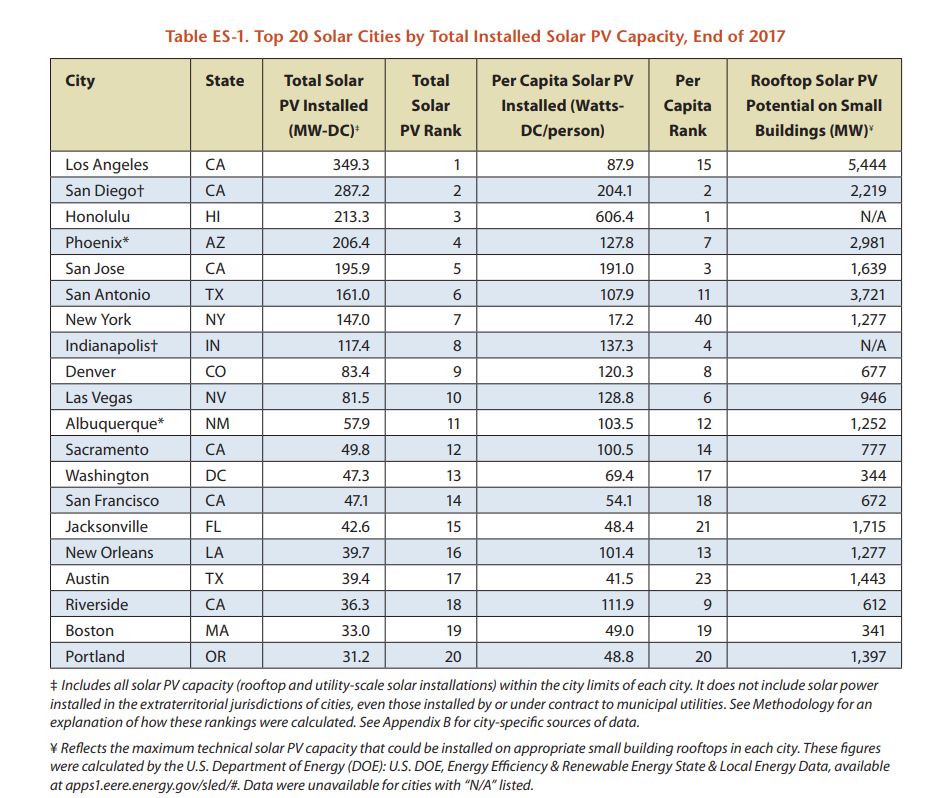 The other city that wasn't as surprising as one might think is San Antonio. While Texas has long been known as a wind market, its solar market is slowly but surely gaining momentum and could eventually place it in the top of solar-friendly states in the country.
 That partnership should be a model for cities around the rest of the country. Fortunately we're seeing more cities commit to 100% clean energy - most often with a strong solar component - and I think this list isn't the end of the race but just the beginning.
And we'd like to thank Environment America for doing the hard work of putting together the list (I've done multiple lists like this over my career and they are largely thankless tasks). I've attached the full report below, and it is great. Go read the whole thing.
More:
Boom time in Texas (pv magazine USA)
[pdf-embedder url="http://www.solarwakeup.com/wp-content/uploads/2018/04/EA_shiningcities2018_scrn-2.pdf" title="EA_shiningcities2018_scrn (2)"]
Bonus:
https://youtu.be/bgiQD56eWDk
That partnership should be a model for cities around the rest of the country. Fortunately we're seeing more cities commit to 100% clean energy - most often with a strong solar component - and I think this list isn't the end of the race but just the beginning.
And we'd like to thank Environment America for doing the hard work of putting together the list (I've done multiple lists like this over my career and they are largely thankless tasks). I've attached the full report below, and it is great. Go read the whole thing.
More:
Boom time in Texas (pv magazine USA)
[pdf-embedder url="http://www.solarwakeup.com/wp-content/uploads/2018/04/EA_shiningcities2018_scrn-2.pdf" title="EA_shiningcities2018_scrn (2)"]
Bonus:
https://youtu.be/bgiQD56eWDk
Moves At SEIA Misguided. Earlier this year, SEIA approached members of their board, many of whom pay for the privilege, on the idea of inviting utilities to join SEIA as members. Many of the board members that were approached called in a non-starter but the idea went high enough at SEIA leadership that it was considered worth floating. The money has become more important to the association than the mission or its values in my opinion. I had to ponder what it meant to have the idea get enough support from leaders to discuss. In line with this new line of thought was the extension of the SEPA joint venture which produces SPI and in 2015 generated over $3.5million in profits to the owners. SEPA is focused on making utilities smarter with their energy systems, it’s not a solar association and in my opinion the values between the two entities no longer align enough to have the joint venture continue, alas it was renewed by the board. What’s next for SEIA in its search for what it stands for and what does that mean for you and its mission going forward? Here is Frank’s exclusive look inside. If you have an opinion on this, I’d love to hear it, please reply to this email and let us know what you think.
SC Solar Push. Hundreds of solar advocates took the fight in South Carolina to the Statehouse steps yesterday. Being this is South Carolina, this was not a partisan fight and focused on the jobs. You could have taken the signs from the protestors in Nevada and used them here which speaks to our message and focus. With the failed nuclear power plants plaguing the political discussion, solar could be the ideal outlet for economic development.
Solar In 2008. Do you remember solar in 2008? What information and advice do you wish you had then that you have today? Storage is like solar in 2008 is the trendiest buzzword in storage conversations but much of that is true. Financing products, innovation for consumers and lead gen are all topics. This article does a good job of going through some of the important issues.
Small Solar In Africa. Africa is such a great opportunity for solar and for the people to enjoy greater access to energy. Small solar upstarts have done a tremendous job growing their companies and deploying with great impact. The other side of that is large scale solar which displaces some of the most ingrained industries in the market and requires offtakers and regulators to work hand in hand, presenting new and different investment issues. I hope Africa does it all, small and large while also doing things like solar power street lights to improve the infrastructure.
SolarWakeup Live! Less than 1 week before we meet in San Francisco. There are some seats left for you to hear from some of the Bay area solar leaders. I hope you will join us for the afternoon. Reserve Your Seat.
Opinion
News
Opinions:
Have a great day!
Yann