

By Frank Andorka, Senior Correspondent What Happened:Sunrun is now one step closer to being able to operate without unreasonable restrictions after the staff of the Florida Public Utilities Commission (FPUC) has recommended that:
By Frank Andorka, Senior Correspondent What Happened:Sunrun is now one step closer to being able to operate without unreasonable restrictions after the staff of the Florida Public Utilities Commission (FPUC) has recommended that:
- Sunrun’s residential solar equipment lease does not constitute a sale of electricity;
- Offering its solar equipment lease to customers in Florida will not cause Sunrun to be deemed a public utility under Florida law;
- The residential solar equipment lease described in its petition will not subject Sunrun or Sunrun’s customer-lessees to regulation by the Commission.
 Because what would a post about Florida be without a photo of Disney World?[/caption]
SolarWakeup’s View: It's been a good year for Sunrun so far. Last month, they seized the leadership position in the U.S. residential segment from Tesla Energy. And this month, they are one step closer to being able to operate unfettered in a market that could soon be one of the hottest in the United States.
As I've written about extensively in previous career stops, Florida was the Bermuda Triangle of rooftop solar for years, in part because the state's utility system wouldn't allow the most popular residential funding mechanism at the time - third-party leasing - to exist. As a result, big third-party leasing companies refused to do business in a state in which it was uneconomical for them to operate.
The winds of change, however, have blown strong through Florida in the past two years, and starting after some significant legislative changes, third party companies have been lining up to enter the Sunshine State, including Sunrun.
Because what would a post about Florida be without a photo of Disney World?[/caption]
SolarWakeup’s View: It's been a good year for Sunrun so far. Last month, they seized the leadership position in the U.S. residential segment from Tesla Energy. And this month, they are one step closer to being able to operate unfettered in a market that could soon be one of the hottest in the United States.
As I've written about extensively in previous career stops, Florida was the Bermuda Triangle of rooftop solar for years, in part because the state's utility system wouldn't allow the most popular residential funding mechanism at the time - third-party leasing - to exist. As a result, big third-party leasing companies refused to do business in a state in which it was uneconomical for them to operate.
The winds of change, however, have blown strong through Florida in the past two years, and starting after some significant legislative changes, third party companies have been lining up to enter the Sunshine State, including Sunrun.
- Sunrun’s residential solar equipment lease does not constitute a sale of electricity;
- Offering its solar equipment lease to customers in Florida will not cause Sunrun to be deemed a public utility under Florida law;
- The residential solar equipment lease described in its petition will not subject Sunrun or Sunrun’s customer-lessees to regulation by the Commission.
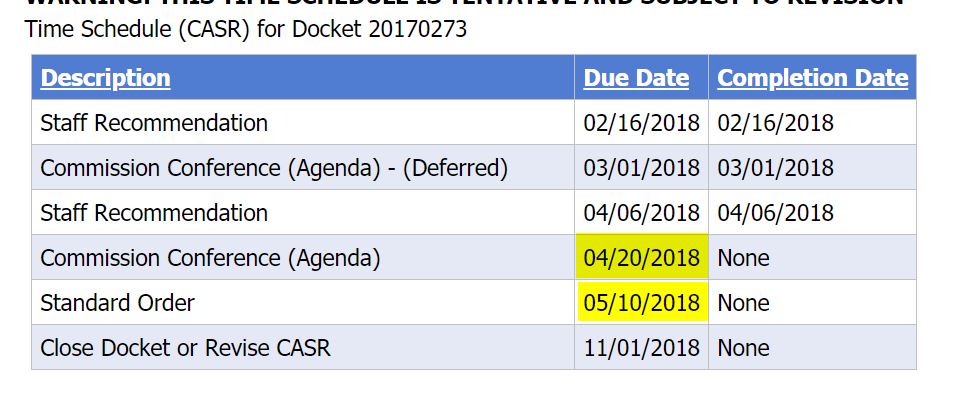 Mark these dates on your calendar and weigh in as you wish.[/caption]
More:
FPSC Staff Recommendation:
[pdf-embedder url="http://www.solarwakeup.com/wp-content/uploads/2018/04/StaffReport.pdf"]
Original Sunrun Petition
[pdf-embedder url="http://www.solarwakeup.com/wp-content/uploads/2018/04/OriginalSunrunPetition.pdf"]
Mark these dates on your calendar and weigh in as you wish.[/caption]
More:
FPSC Staff Recommendation:
[pdf-embedder url="http://www.solarwakeup.com/wp-content/uploads/2018/04/StaffReport.pdf"]
Original Sunrun Petition
[pdf-embedder url="http://www.solarwakeup.com/wp-content/uploads/2018/04/OriginalSunrunPetition.pdf"]
SC Takeaway. SC isn’t the likeliest candidate for taking strong solar steps forward, on the face of it. SC is very conservative and does not require bipartisan agreement to move legislation forward. When you compare SC to other nearby States, the main difference is the recent trouble by the utilities charging for and not building the nuclear power plants. I don’t know if legislative success would have been different without the nuclear blunder but I would say that advanced cost recovery for nuclear development is not isolated to South Carolina and it’s not going well in other places either. The desire to build new power plants is universal amongst utilities with rate base, that may be the trend that Vote Solar sees an opportunity in just as they did in Michigan.
The RPS Year? We’ve already seen the ballot initiative trend about moving the RPS up in a few places under the Steyer banner. We also know that Nevada and California will be working on this in the legislative avenues after last year’s attempts that fell short. New Jersey is also into the game now that the Governor's office is a bit more receptive that under Christie. Phil Murphy has been a vocal supporter of our industry and has advisors that are also on our side. On a personal note, US Ambassador to Germany is definitely a gig I would sign up for.
The Storage Industry. I’d be surprised if the solar jobs census next year doesn’t include data for energy storage. This is a market segment growing very rapidly and generating value on economic development and grid infrastructure.
Montana NEM Report. Montana may be the first state to figure out how to value distributed solar lower than the avoided cost used for PURPA contracts. (Maybe not really but it can’t be far off) Reports like this have been seen in other states as well and it’s a troubling distortion of facts. Net metering at its best form is a simple way for consumers to produce their own energy. It creates a benefit for the party making the investment and more importantly a benefit to the system.
Send Tips. You can reach Frank and me by replying to this email or sending an email to frank@solarwakeup.com. If you have data that you want to send confidentially, you can use the tips or contact form on solarwakeup.com
Opinion
News
Opinions:
Have a great day!
Yann
By Frank Andorka, Senior Correspondent What Happened:Solar electricity wracked up an enormous victory in South Carolina yesterday when the House of Representatives eliminated the prevailing net metering caps on residential installations.
By Frank Andorka, Senior Correspondent What Happened:Solar electricity wracked up an enormous victory in South Carolina yesterday when the House of Representatives eliminated the prevailing net metering caps on residential installations.
- But don't spike the ball too early: The issue now goes before the state's Senate, where the debate is expected to be just as contentious as it was in the lower chamber. .
- Yes, the utilities are trotting out the cost-shift fabrication again - but I won't spend too much time on it right now because I'm in a celebratory mood.
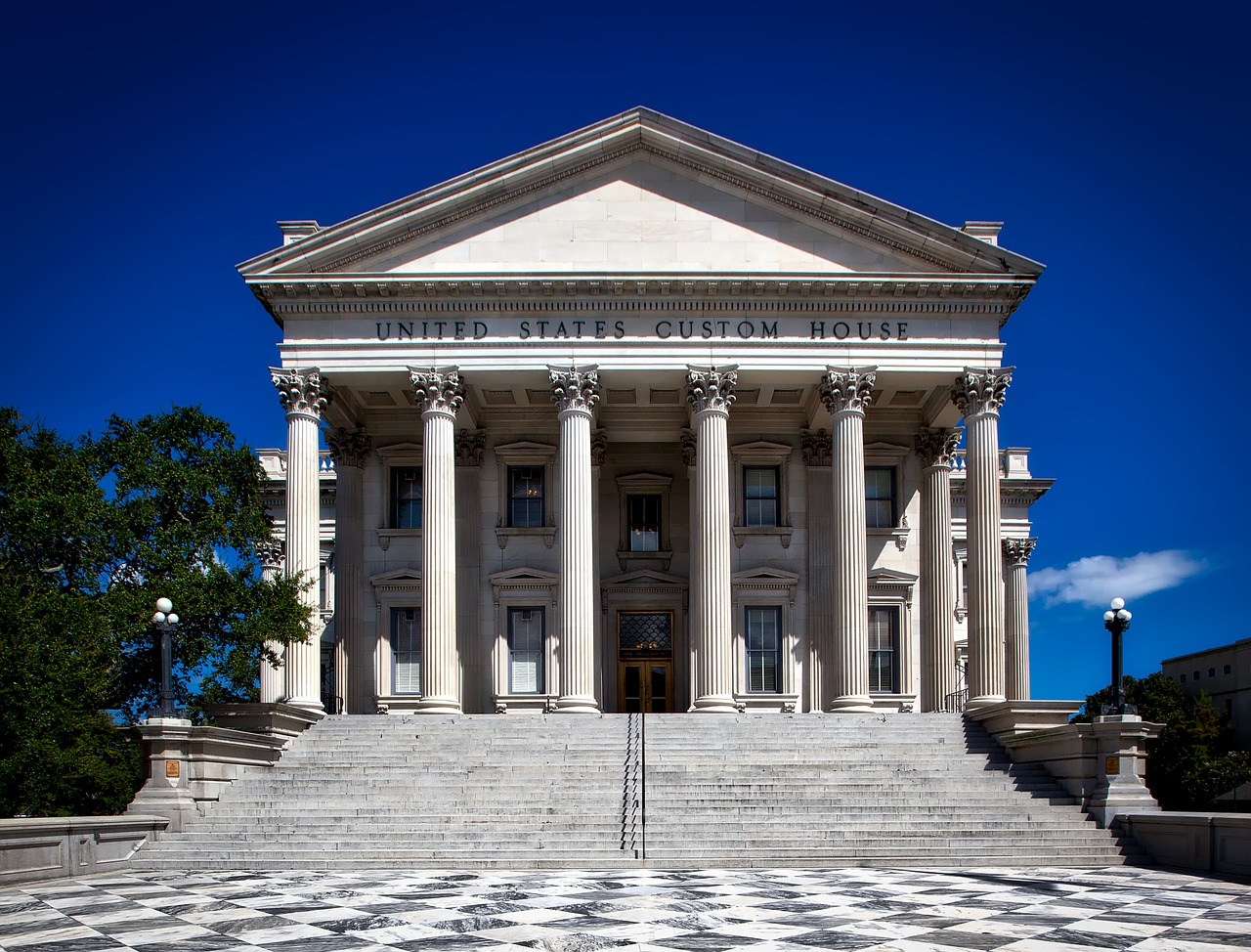 South Carolina should get ac-CUSTOMED to more residential solar installations (see what we did there? It's a Custom's House in Charleston. See. Cust....oh never mind).[/caption]
SolarWakeup’s View: Maybe South Carolina is sick and tired of being in the shadow of its northern neighbor when it comes to discussions of being a top solar state. Whatever the reason, the residential solar industry in the southern stronghold got an initial boost yesterday as the House of Representatives passed legislation removing the net metering caps that had hampered to growth of the residential segment.
As the debate raged over whether to remove the caps or not, installers worried the net metering restrictions - which the state was rapidly approaching as solar boomed - would inhibit further growth and cause job losses as new installations dwindled.
The victory stunned some observers, especially since a utility-backed bill was on the floor at the same time (it failed). Duke Energy expressed disappointment in the to the Charleston (South Carolina) Post & Courrier newspaper, but one representative/solar advocate could barely contain his excitement.
South Carolina should get ac-CUSTOMED to more residential solar installations (see what we did there? It's a Custom's House in Charleston. See. Cust....oh never mind).[/caption]
SolarWakeup’s View: Maybe South Carolina is sick and tired of being in the shadow of its northern neighbor when it comes to discussions of being a top solar state. Whatever the reason, the residential solar industry in the southern stronghold got an initial boost yesterday as the House of Representatives passed legislation removing the net metering caps that had hampered to growth of the residential segment.
As the debate raged over whether to remove the caps or not, installers worried the net metering restrictions - which the state was rapidly approaching as solar boomed - would inhibit further growth and cause job losses as new installations dwindled.
The victory stunned some observers, especially since a utility-backed bill was on the floor at the same time (it failed). Duke Energy expressed disappointment in the to the Charleston (South Carolina) Post & Courrier newspaper, but one representative/solar advocate could barely contain his excitement.
"We're no longer competitive in being able to attract industry because we have some of the highest (electricity) rates in the country," said state Rep. James Smith, D-Columbia, during an hours-long debate on the House floor [according to the newspaper]. "We've got to change that. This bill will do it."
We had a major victory yesterday with the house passing the bill but its headed to the Senate where its going to be a heated debate. If this bill goes through, [South Carolina] will become one of the top solar friendly states in the country and it's important for everyone to see and understand the process the bill makes/or doesn’t make as it moves through our legislative system. I hope that [our state] can be a beacon of light for other states and their citizens to keep fighting and pushing for more progressive energy policies that work for the people not the “public” utilities.Maybe soon South Carolina will stand beside its northern neighbor in the sunlight instead of being hidden in its shadow. More: In victory for solar industry, South Carolina House votes to keep lower costs for rooftop panels (James Lovegrove, Charleston (South Carolina) Post and Courrier) OK, here's your "cost-shift" refresher. You're really bringing me down here. Zombie Lie Returns; Time To Kill It Again
By Frank Andorka, Senior Correspondent What Happened:The New Jersey legislature got about the business of undoing former Governor Chris Christie's treachery when it came to the solar industry, passing two companion bills out of committees in the House and Senate that would fix Christie's mischief by increasing the state's RPS and create a community solar program.
By Frank Andorka, Senior Correspondent What Happened:The New Jersey legislature got about the business of undoing former Governor Chris Christie's treachery when it came to the solar industry, passing two companion bills out of committees in the House and Senate that would fix Christie's mischief by increasing the state's RPS and create a community solar program.
- On his way out the door, Christie "pocket-vetoed" a bill that would have increased the state's RPS, a move the state's solar industry says is desperately needed to maintain its strength as a market.
- Now, under a governor who has unceasingly pledged his undying love to the industry, the two companion bills in the House and Senate have moved one step closer to passage and Governor Phil Murphy's expected signature.
- Though nothing is ever a done deal until the ink is dry with the governor's signature, the moves yesterday gave the state's solar advocates a much-needed victory in a market in need of stability after years of turmoil.
 Atlantic City, New Jersey, might be able to expand its use of solar if two new bills are eventually passed and signed into law by Governor Phil Murphy.[/caption]
SolarWakeup’s View: Thankfully, it appears Maine's incessant desire to destroy its own solar industry is the exception instead of the rule in state legislatures these days.
Following a victory for the clean-energy industry in South Carolina on the same day, two companion bills passed their respective House and Senate committees and moved one step closer to passage in the New Jersey legislature - after which Governor Phil Murphy could reasonably be expected to sign a combined measure.
"New Jersey was one of the pioneering states in the solar industry," said Tony Clifford, CDO of Standard Solar, a Maryland-based national solar company. "It's great to see the legislature taking actions that will re-energize the industry in the state and create a strong and dynamic solar market going forward."
According to the New Jersey Conservation Foundation, the bills would:
Atlantic City, New Jersey, might be able to expand its use of solar if two new bills are eventually passed and signed into law by Governor Phil Murphy.[/caption]
SolarWakeup’s View: Thankfully, it appears Maine's incessant desire to destroy its own solar industry is the exception instead of the rule in state legislatures these days.
Following a victory for the clean-energy industry in South Carolina on the same day, two companion bills passed their respective House and Senate committees and moved one step closer to passage in the New Jersey legislature - after which Governor Phil Murphy could reasonably be expected to sign a combined measure.
"New Jersey was one of the pioneering states in the solar industry," said Tony Clifford, CDO of Standard Solar, a Maryland-based national solar company. "It's great to see the legislature taking actions that will re-energize the industry in the state and create a strong and dynamic solar market going forward."
According to the New Jersey Conservation Foundation, the bills would:
- Mandate that New Jersey gets more than 50% of its energy from renewable sources like solar and wind by 2030, a fourfold increase in the next 12 years over the progress made since 2001, while protecting customers with a cap on the cost.
- Create a community solar program that will ensure all customers will have access to the benefits of solar energy for the first time, including low-income and multi-family residence customers.
- Establish an energy efficiency program that would decrease harmful emissions from the power sector by approximately 350,000 metric tons per year, the equivalent of removing approximately 75,000 cars from the roads per year.