

The Energy Show, a podcast by Barry Cinnamon is now available on SolarWakeup
We call our power system an electric “grid” because it is composed of a network of wires that move the power around from node to node – basically a combination of power sources (natural gas power plants, solar farms, nukes), wires (long distance transmission lines and local distribution utility poles) and controls. Microgrids are the same concept but on a much smaller scale.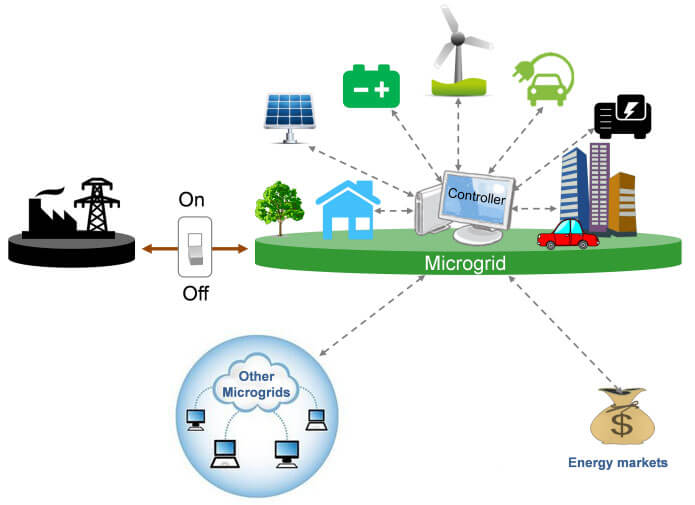
The Energy Show, a podcast by Barry Cinnamon is now available on SolarWakeup
We call our power system an electric “grid” because it is composed of a network of wires that move the power around from node to node – basically a combination of power sources (natural gas power plants, solar farms, nukes), wires (long distance transmission lines and local distribution utility poles) and controls. Microgrids are the same concept but on a much smaller scale.
By Frank Andorka, Senior Correspondent What Happened: Jigar Shah talked with GreenBiz writer Lucy Kessler to discuss how taxes and tariffs are going to affect the future of the solar industry.
By Frank Andorka, Senior Correspondent What Happened: Jigar Shah talked with GreenBiz writer Lucy Kessler to discuss how taxes and tariffs are going to affect the future of the solar industry.
- In the interview, he argues the "sky is falling" mentality the solar industry has surrounding President Trump's ill-advised tariffs on imported modules is counterproductive and overblown.
- He also believes that while the tax-code changes may slow tax-equity financing in solar temporarily, the dust will settle once everyone understands the details of the law.
 SolarWakeup’s View: Ever since I joined the solar industry in 2011, the name Jigar Shah has been spoken in the hushed tones usually reserved for the Pope or, in certain circles, Bruce Springsteen - and with good reason.
Shah was one of the earliest investors to recognize the future of solar before it became the hip electricity source it is now, and he built an extraordinarily successful business in SunEdison (its collapse happened long after he had left). Now co-founder and president of Generate Capital, Shah is still one of the most sought-after opinion leaders in the solar industry, which is why GreenBiz did an interview with him on the subject of the solar tariffs, tax-law changes and state-level solar policy initiatives.
The whole interview is interesting because, as someone who has already seen some of the harshest cycles the solar industry has been through, Jigar Shah can stand back and look at the current policy upheaval with the unbiased eye of an outsider.
(And Jigar Shah is unflappable. I remember watching him get hounded one year at the Midwest Solar Expo by some snot-nosed reporter from an upstart solar publication about the first round of SolarWorld Americas trade actions, and he handled my incessant nagging with otherworldly grace and aplomb.)
But the point I found most fascinating, in part because it does feel like so few other people are talking about it, is where Jigar Shah talks about the future of solar manufacturing and says tariffs aren't the right policy mechanism to restore it. Instead, he suggests the United States finally join the rest of the developed Western world and develop a national, integrated, coherent industrial policy.
I don't know if he could hear me, but I stood up in Cleveland, Ohio, and cheered as loudly as if the Browns had won the Super Bowl.
Shah told Kessler:
SolarWakeup’s View: Ever since I joined the solar industry in 2011, the name Jigar Shah has been spoken in the hushed tones usually reserved for the Pope or, in certain circles, Bruce Springsteen - and with good reason.
Shah was one of the earliest investors to recognize the future of solar before it became the hip electricity source it is now, and he built an extraordinarily successful business in SunEdison (its collapse happened long after he had left). Now co-founder and president of Generate Capital, Shah is still one of the most sought-after opinion leaders in the solar industry, which is why GreenBiz did an interview with him on the subject of the solar tariffs, tax-law changes and state-level solar policy initiatives.
The whole interview is interesting because, as someone who has already seen some of the harshest cycles the solar industry has been through, Jigar Shah can stand back and look at the current policy upheaval with the unbiased eye of an outsider.
(And Jigar Shah is unflappable. I remember watching him get hounded one year at the Midwest Solar Expo by some snot-nosed reporter from an upstart solar publication about the first round of SolarWorld Americas trade actions, and he handled my incessant nagging with otherworldly grace and aplomb.)
But the point I found most fascinating, in part because it does feel like so few other people are talking about it, is where Jigar Shah talks about the future of solar manufacturing and says tariffs aren't the right policy mechanism to restore it. Instead, he suggests the United States finally join the rest of the developed Western world and develop a national, integrated, coherent industrial policy.
I don't know if he could hear me, but I stood up in Cleveland, Ohio, and cheered as loudly as if the Browns had won the Super Bowl.
Shah told Kessler:
I honestly think it’s more about the United States having an industrial policy. Does the United States actually want manufacturing in this country? If it does, it needs to support those companies, like they do in Canada and Germany. We have to provide financial incentives such as loans or grants to get these companies to manufacture here, as other countries do. Tariffs are not going to support manufacturing in the United States. I think the opportunity is ripe, but only if the federal and state governments have proactive industrial policies.It's clear to any seasoned solar observer that the idea that tariffs will bring back solar manufacturing is idiotic. To my knowledge, only one company has decided for sure to build a new factory in the country, and its commitment has turned into the incredibly shrinking Jacksonville plant. There are rumors of others, but as of now they are just that - rumors. One company that tried to save itself with the tariffs is near to being sold off for parts, and despite loud promises, only whispers are coming out of the other's headquarters now. In the end, Shah's forward-thinking idea is the way to bring solar manufacturing back to the United States. If only our leaders in Washington could hear and heed Shah's "radical" advice (it's only radical in this country). More: An optimistic Jigar Shah talks tariffs, taxes and state leaders in clean energy
By Frank Andorka, Senior Correspondent What Happened: Damn, that was cold - although you have to admire solar's opponents in South Carolina for employing an obscure legislative sleight of hand to kill a bill that would have eliminated residential net metering caps.
By Frank Andorka, Senior Correspondent What Happened: Damn, that was cold - although you have to admire solar's opponents in South Carolina for employing an obscure legislative sleight of hand to kill a bill that would have eliminated residential net metering caps.
- After the utilities raised all holy hell about how removing net metering caps would COMPLETELY DESTROY THEIR BUSINESS RIGHT NOW, the cowards in the South Carolina House of Representatives reclassified the bill as a tax increase, which mean it needed a 2/3 majority instead of a simple majority.
- So...solar advocates in South Carolina can kiss the expected industry expansion goodbye, at least for now.
 SolarWakeup’s View: Those of you who know me recognize me as one of the most cynical human beings in the world, especially when it comes to the Wild-West world of politics. But even my breath was taken away by how brazenly South Carolina's utility monopoly stole a solar-expansion bill out from under the industry with an obscure legislative maneuver that twisted the bill's purpose into something unrecognizable, even to its own sponsor.
Remember that article I wrote all the way back on Friday? About how the South Carolina House of Representatives had voted to lift residential solar net metering caps, a move destined to expand the state's burgeoning solar industry and bring it more in line with its northern neighbor? Remember how I suggested that we not celebrate quite yet because it still had to pass the Senate before becoming law?
Little did I know the utility monopolies would buy their way back into the House to kill it there before it even had a chance to be debated in the upper house.
Through a legislative sleight of hand, the bill - which passed with a majority just last Friday - magically became a "tax increase" bill, which requires a vote of 2/3 of representatives instead of a majority. As a result, another vote was taken, and the bill failed to get to 2/3 by nine votes.
I mean...wow. Just. Wow.
The gobsmacking chicanery in South Carolina highlights a question that is central to whether solar will continue to thrive in this country: Will we continue to let state-supported utility monopolies continue to keep the United States from modernizing and updating our electric-generation system? Or will the people - who, as I wrote about yesterday, want a distributed-generation solar future - finally say, "Enough is enough."?
It's time to hold state representatives who decide to side with utility monopolies over their constituents accountable. Let's vote the bastids out.
More:
South Carolina House kills pro-solar bill after last-minute rule change
The Latest: Solar Energy Bill Killed in Legislative Surprise
South Carolina Sends Solar Soaring With Cap Removal
SolarWakeup’s View: Those of you who know me recognize me as one of the most cynical human beings in the world, especially when it comes to the Wild-West world of politics. But even my breath was taken away by how brazenly South Carolina's utility monopoly stole a solar-expansion bill out from under the industry with an obscure legislative maneuver that twisted the bill's purpose into something unrecognizable, even to its own sponsor.
Remember that article I wrote all the way back on Friday? About how the South Carolina House of Representatives had voted to lift residential solar net metering caps, a move destined to expand the state's burgeoning solar industry and bring it more in line with its northern neighbor? Remember how I suggested that we not celebrate quite yet because it still had to pass the Senate before becoming law?
Little did I know the utility monopolies would buy their way back into the House to kill it there before it even had a chance to be debated in the upper house.
Through a legislative sleight of hand, the bill - which passed with a majority just last Friday - magically became a "tax increase" bill, which requires a vote of 2/3 of representatives instead of a majority. As a result, another vote was taken, and the bill failed to get to 2/3 by nine votes.
I mean...wow. Just. Wow.
The gobsmacking chicanery in South Carolina highlights a question that is central to whether solar will continue to thrive in this country: Will we continue to let state-supported utility monopolies continue to keep the United States from modernizing and updating our electric-generation system? Or will the people - who, as I wrote about yesterday, want a distributed-generation solar future - finally say, "Enough is enough."?
It's time to hold state representatives who decide to side with utility monopolies over their constituents accountable. Let's vote the bastids out.
More:
South Carolina House kills pro-solar bill after last-minute rule change
The Latest: Solar Energy Bill Killed in Legislative Surprise
South Carolina Sends Solar Soaring With Cap Removal
What Energy Future Do You Want? Sunrun has been busy this week. CEO, Lynn Jurich, has authored a report that asks the question we already know the answer to, what should be the default scenario for utility investments going forward? Do we rebuild the century old poles, plants and wires or focus on distributed generation in smart energy systems? For Sunrun, and others, the hope is to get consumers upset at the status quo and expect a newer, better system. My hope is this report makes it into the mainstream, it’s lengthy but simple enough to be understood by those outside of our industry. Here is the report
My Convergence Thesis Is Coming True. Solar is a vital part of the EV revolution which means that as the energy sector seeks new generation caused by automobile OEMs building more EVs, the two sectors will come together into one. Your utility, solar contractor, auto manufacturer and energy IPPs will all serve the same market. Look to the latest move at E.ON as a BMW board member joins the supervisory board.
Energy, Carbon, And Baseload. I didn’t watch the BNEF Summit live, just reading the twitter coverage makes me realize how we are still stuck in the past in so many ways. Wind and solar development are causing our energy grid to get cleaner (and cheaper) but holding back the replacement of fossil based plants is delaying the inevitable. I get that Tom Fanning and Rick Perry make for nice names to have at a conference but I don’t understand having Bob Murray the coal magnate at the NEW energy finance summit.
More On Murray. He has some funny commentary about his oil and gas colleagues. Sub-tweet is the fact that he’s showing who is true enemy is and what really killed coal.
Unrated Credit. As a reminder to you, each afternoon Frank writes up the story you found most interesting in that day’s SolarWakeup email. The story that gets the most clicks gets a follow up. I spoke with CleanCapital’s President, Jon Powers, about what the raise means to the company and how it advances C&I solar.
Opinion
News
Opinions:
Have a great day!
Yann