

Let’s Get High(er): GE Unveils 853-Foot Wind Turbine (Plans)

By Frank Andorka, Senior Correspondent

What Happened: GE unveiled its latest wind turbine, the Haliade-X. It will

  • Stand 853-feet tall.
  • Have blades the length of a football field.
  • Will, if all goes according to plan, will produce 67 GWh annually (Vox calls that “whackadoodle.”)

SolarWakeup’s View: First off, let me say my first reaction to this story was, “Whoa – that is one enormous wind turbine.”

But then it got me to thinking: When a utility retires a fossil-fuel-fired plant, how much wind and solar will we need to replace all that generation? The answer is a ton.

When a plant is retired, it takes a lot of megawatts with it. If you multiply those megawatts by the capacity factor, the amount of electricity production that is actually disappearing is staggering – and it provides an enormous opportunity for solar and wind to take up that space.

Here’s the rub, however: The wind industry seems to have realized how much production it will have to make up, and they are engineering their new technology to account for it. From our vantage point, the solar industry lags a bit behind its renewable energy cousin. It’s time for us to get with the program.

Although it’s true energy storage is the hot new technology, with breakthroughs coming at an ever-quickening pace (see our article yesterday on DC-coupled battery storage), it’s important not to forget that flexibility still requires energy generation.

The bottom line is this: Whatever else we are focusing on in the industry, it’s time we did some long-term planning to account for the sheer volume of electricity production we’re going to need to make up – and get our technology ready to fill that need.

More 

GE Renewable Energy Secured $10.4 Billion In Orders In 2017 (CleanTechnica)

E030: GE Invests In Renewable Energy To Grow Its Power Business With Daniel Hullah of GE Ventures
For Michigan, It Should Be All About Renewable Energy Jobs

By Frank Andorka, Senior Correspondent

What Happened: A report by Vote Solar and the Union of Concerned Scientists revealed that if DTE Energy, a Detroit-area utility, implemented a renewable/energy efficiency portfolio instead of a $1 billion, 1,100 MW natural gas plant

  • Would provide more than 10-times the number of construction jobs.
  • Add slightly less than 4-times the number of permanent jobs.
  • Would generate $213.5 million in local and state taxes and $41.1 million in federal taxes.

SolarWakeup’s View: I love Vote Solar. The work they do to advocate for the industry almost flies under the radar unless you’re paying close attention, but they have been instrumental in battling anti-solar policies and projects in states across the nation for years.

Their latest battleground is Michigan, where Detroit-based utility DTE Energy has asked the PUC for permission to build an 1,100 MW natural gas plant to replace the coal plants they are retiring. Going on the offense, Vote Solar says the investment would

be a waste of time and money because renewable sources would bring far more benefits.

Now there is data to back that up.

A new study by BW Research, commissioned by Vote Solar and the Union of Concerned Scientists, reveals that investments in a portfolio of solar, wind and energy efficiency programs would create more jobs, generate more taxes and, according to UCS, cost $340 million less to build.

The study comes merely three weeks after DTE’s CEO said the utility would be 100% coal-free by 2040.

This is how public participation/pressure is supposed to work, and Vote Solar has gotten really good at it. In the face of the jobs numbers in this study, it should be intensely uncomfortable for the PUC to vote to support DTE’s harebrained natural gas plant plan. Doesn’t mean they won’t do it, of course, but the solar industry shouldn’t make it easy for them to do so.

Go get ‘em, Vote Solar. You can help Vote Solar by joining them at Equinox 2018.

More 

Vote Solar Equinox 2018

Full Vote Solar and Union of Concerned Scientists Report

Can EVs Save The Utility Model?

By Frank Andorka, Senior Correspondent

What Happened: Quartz Media reports that as distributed generation continues to peel off customers from utilities, they

  • are increasingly turning to electric vehicles (EVs) as their business-model savior, and
  • are designing incentives to get their current customers to purchase them.

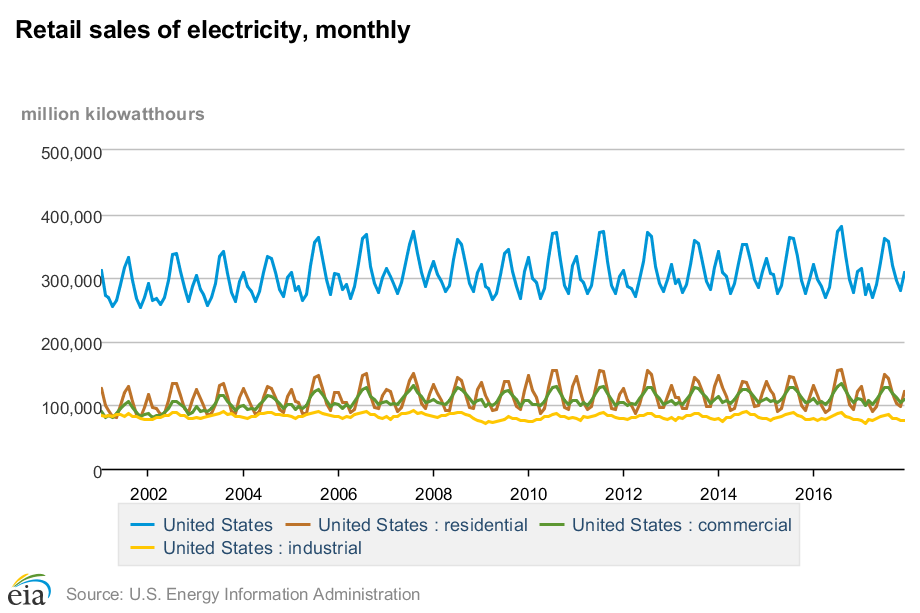
SolarWakeup’s View: The charts below are striking fear into the hearts of utilities everywhere – electricity demand is flatter than Interstate 70 through Kansas.

So if you’re a regulated utility that has realized new generation will be hard to justify going forward, where do you turn to keep growing the ratebase? For many utilities, that life extension may come in the form of EVs.

Sure, it’s a loss leader – like selling a printer so

customers have to buy the ink, or selling an ant job to get the termite business (termites are where the money is, baby) – but the utilities must figure out a way to grow electricity demand. Otherwise, their raison d’etre and, along with it, the millions of dollars of profits.

Since it may be the only way to save the utilities’ historical business model, look for more utilities to get into this game soon.

More 

Utilities are paying their customers to buy electric vehicles (Quartz)

After rising for 100 years, electricity demand is flat. Utilities are freaking out. (Vox)

EIA Interactive Data

Is DC-Coupled Storage The Next Solar Boom Segment?

By Frank Andorka, Senior Correspondent

What Happened: Our own Yann Brandt, the proprietor of this place, interviewed Josh Prueher, CEO of FlexGen, about the concept of DC-coupled energy storage and what it could mean for the solar industry.

  • What are the major advantages of DC versus AC coupled energy storage for solar?
  • How does solar start integrating storage in its projects?

SolarWakeup’s View: As the race to unlock the solar+storage market heats up, the idea of DC-coupled storage is an intriguing one. In such a system, the storage devices are placed between the solar modules and the inverter, instead of the traditional configuration of putting it behind the inverter.

“OK, Frank, but what difference does that make?”, I can hear you saying out there. Here’s the difference it makes: It means there are fewer components to install, meaning there are fewer parts to break down. In addition, you eliminate the unnecessary step of converting DC power to AC power (at the inverter) and then back to DC power (at the storage level) and then back to AC to deliver the electricity to the offtaker.

It lowers installation costs and stabilizes the entire project, including the power-output percentage. Such stability makes projects much easier to finance. And if you don’t think financiers are attracted to stability, I’d respectfully suggest you’ve never met a financier.

At the moment, FlexGen is focusing on adding storage to existing C&I and utility-scale projects, but as the technology becomes better understood, Prueher expects it to become another storage option mandated by these projects before they have even begun.

The concept of DC-coupled storage is an interesting one that is just coming into its own – and has the potential to revolutionize the storage industry as we know it.

More 

FlexGen Solar Case Study