
Hey, California Utility: John Grisham Would Like His Latest Plot Back

By Frank Andorka, Senior Correspondent

What Happened: If you’ve ever doubted whether utilities fear that solar will put them out of business, read Sammy Roth’s excellent report in The Desert Sun, in which he

  • Discovered that a public utility had an “oppo research” department to find dirt on the owner of Renova Energy, an outspoken critic of the utility, and
  • Used ratepayer money to hire private investigators for this fishing expedition.

SolarWakeup’s View: Let’s get this out of the way first: If you’re not reading Sammy Roth in The Desert Sun regularly, what the heck is wrong with you? He covers solar in California as well as anyone I know, so bookmark him.

But even I was gobsmacked by his story yesterday, in which he reported that public utility Imperial Irrigation District (a utility about which Sammy wrote a superb series exposing corruption in its ranks – go figure) hired private investigators, using ratepayer funds, to investigate Vincent Battaglia, CEO of Renova Energy, the largest rooftop solar installer in IID’s service area.

Let that sink in for a moment.

Battaglia’s “sin” was to be critical of the utility for abruptly shutting down its net metering program, which of course made solar less attractive to homeowners. In other words, IID launched a direct attack on Battaglia’s – and other solar installers’ – livelihoods.

So…a public utility took the extraordinary step of trying to destroy Battaglia and his company with a concerted effort to dig up dirt on him – using public funds.

It takes a lot to shock me anymore, but this story took my breath away – and it is absolutely worth reading in its entirety (the link is below). But here’s my takeaway: The solar industry has the utilities running scared.

I’m sure many of you in our audience are saying, “Nice insight, Sherlock.” And I admit that’s probably obvious to most of us in the industry. But what’s different here is that the information is now out in the public, and if we can capitalize on this incident to mobilize the public on our side, that will be an enormous boon to the spread of solar to more places. Sammy deserves our thanks for exposing it – keep it up, my friend.

(Speaking of Sherlock Holmes, the private investigators hired by IID was the Baker Street Group, a tribute to the iconic detective’s residence at 221B Baker Street in London.)

(Oh, and if you’re interested in reading about the widespread corruption at IID, I can’t recommend Sammy’s series enough. There’s a link to it in the story below.)

More 

Public agency paid private investigators for ‘opposition research’ on local solar company
Are The Russians Trying To Hack Our Grid? Trump Thinks So

By Frank Andorka, Senior Correspondent

What Happened: At 10:55 am, Trump Administration officials told assembled reporters that the intelligence community

  • Has determined Russia is behind attempts to penetrate our electricity grid and have done so successfully.
  • The U.S. is sending an alert to energy companies to raise threat awareness.

SolarWakeup’s View:  It’s not enough that the Russians may have hacked our elections in 2016. Now they’re trying to take down our electrical grid.

The Associated Press first reported the story and is slowly being picked up by other media outlets. The information is scarce at this point, but according to national security officials that spoke to the AP anonymously, the FBI, the Department of Homeland Security and other intelligence agencies have identified the Russians as being behind a series of hacks into the control centers of our electrical grid.


Officials told the AP the hacks were doing what they called “network reconnaissance” and have been rebuffed. They also told the AP they were sending out warnings to all energy companies to be on the lookout for further hacks.

But if history is any guide, now that the Russians have figured out how to do this, they will be back.

The issue of grid security and its vulnerability to cyberattacks has been in the news for a while now, and numerous reports have indicated the risk is rising. The administration’s announcement today shouldn’t surprise anyone, but it should terrify all Americans.


The chaos the Russians could wreak by causing blackouts around the country would affect nearly every single one of us, given how dependent we are on electricity to live our lives every day. Unfortunately – and frighteningly – these hacks show how woefully underprepared the United States is to defend itself against these attacks.

As we’ve discussed multiple times recently, the U.S. grid is not designed to handle 21st century electricity generation and, apparently, is unable to handle this new type of warfare – one our biggest international threat has gotten quite good at fighting.

That’s why solar is so important to our national security. As I mentioned earlier this week, a distributed generation-ready grid would make it much more difficult for centralized attacks like this to take out all the electricity production around the country at once.

And while I understand that utilities are scared of this next evolution because it could potentially put them out of business, solar is the best distributed generation technology in the electricity game.

The Trump Administration’s comments today are incredibly troubling, and it’s time we got serious about grid security. I maintain that solar is the answer to the question: How do we keep the Russians (or anyone else, for that matter) from interfering in our electrical grid?

Solar Adds 10.6 GW To Capacity In 2017, Defying All Logic And Reason

By Frank Andorka, Senior Correspondent

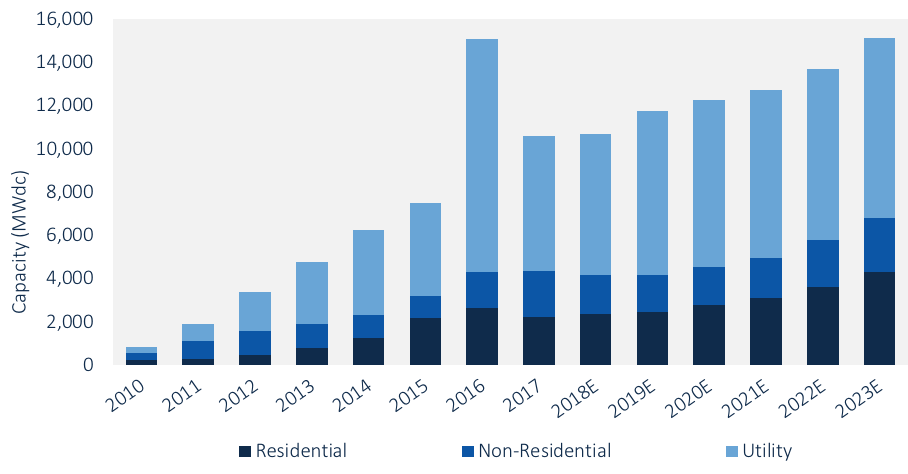
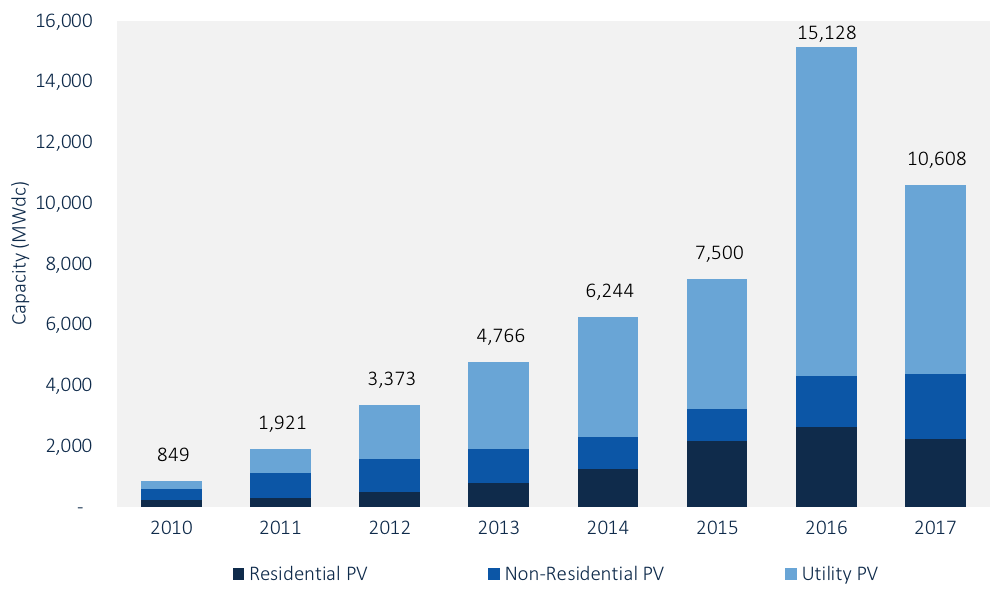
What Happened: SEIA and GTM Research finally closed the book on 2017 with the release of their U.S. Solar Market Insight report, which indicated the following (quoting directly from the release)

  • In 2017, the U.S. market installed 10.6 GW-DC of solar PV, a 30% decrease year-over-year from 2016.
  • In 2017, 30% of all new electric generating capacity brought online in the U.S. came from solar, ranking second during that period only to natural gas.
  • Q4 2017 saw price increases in most PV market segments stemming from increases in module costs. This was due to a global shortage of Tier 1 module supply and the uncertainty spurred by the Section 201 petition. But the price increases were mitigated by falling prices in racking and inverters, improving operating efficiencies and likely margin compression.

SolarWakeup’s View:  It’s never easy to step into a legend’s shoes. Who would want to follow in Jerry Rice’s shoes? Or be the next small forward in Cleveland after LeBron? Or trying to pitch in Los Angeles after Clayton Kershaw ends his mastery on the mound?

So let’s be real: 2017 never really had a chance.

Following a record-breaking 2016 in terms of installed solar capacity, it was inevitable that 2017 would fall short in comparison – and that’s just what the most recent SEIA/GTM Research U.S. Solar Market Insight report did show.

Installed capacity: Off 30%. Price increases. A residential market in seeming freefall, and a utility-scale sector trying to rediscover its footing in the swirling uncertainty of the tariff debate.

Based on the tumultuous and uncertain status of the solar industry last year, some industry observers said the drop in installed capacity was exactly what they expected.

“I wasn’t surprised when I saw the numbers came out,” said Mathew McGovern, CEO of Cypress Creek Renewables, a nationwide developer that has been intensely active in protecting PURPA and net metering in states across the country. “The market froze mid-year when 201 hit industry consciousness, then panel prices jumped.”

Daniel Shugar, CEO of NEXTracker, said the U.S. market fell because of the uncertainty surrounding how large the tariffs Trump seemed hellbent on imposing would be – an uncertainty that wasn’t resolved until January.

Source: GTM Research / SEIA U.S. Solar Market Insight Report

“It’s not rocket science,” Shugar said. “Until January, no one knew how much tar

iff penalty would be imposed on PV module costs. As a result, many projects were deferred.”

“Some projects died due to the added cost of modules, but fundamentals are still strong for the industry to rebound in 2019,” Shugar added.

The reduced percentage of installed capacity can’t solely be blamed on the tariffs, however. Costa Nicolaou, CEO of PanelClaw, said 2017 suffered from the hangover from the last federal policy fight over the investment tax credit (ITC).

Source: GTM Research / SEIA U.S. Solar Market Insight Report

“There was a lot of demand pull-in in utility scale at the end of 2016 because everyone assumed the ITC would end in 2016, so they moved their project timelines up significantly to make sure they could take advantage of it,” Nicolaou said. “Even despite that, 2017 had all the hallmarks of being a great year – then the Section 201 complaint was filed, and that dumped a bucket of ice water on our fire.”

But there is some good news in the report. After all, even though it doesn’t equal 2016’s incredible numbers, the industry did still install 10.6 GW last year. Furthermore, while the residential sector is cratering in many states and the utility-scale market is faltering, the commercial and community markets grew 28%, marking its fourth straight year of significant increases.

“We are excited to see commercial solar be one of the driving forces behind the continued growth of the industry,” said Tony Clifford, chief development officer for Maryland-based Standard Solar. “While no one expected last year to be as big as 2016, 10.6 GW is still a great accomplishment, especially in the face of such uncertainty.”

“This is yet more proof that the solar industry is on such solid footing that even difficult circumstances can’t hinder its growth,” Clifford said.

Jesse Grossman, CEO of Soltage, a New Jersey based developer of commercial

“We were heartened to see this report today, showing that solar continues to post strong annual build numbers even in years with stiff headwinds,” said Jesse Grossman, CEO of New Jersey-based Soltage. “2017 saw a number of challenges to the solar sector, with the uncertainty of the trade case, pending tax reform, and a rationalization of business models in some parts of the residential sector.”

“The emerging development models in the utility-scale and commercial segments continued to show strong growth, however, and I expect that growth to continue again in 2018,” Grossman added.

In all, the U.S. Solar Market Insight report is, as was likely expected, a mixed bag for the industry. But despite its struggles, the solar industry persisted. And sometimes, that’s all for which you can ask.


Tesla Is Speeding Up The Building Of Its 70MW PV System In Nevada

By Frank Andorka, Senior Correspondent

What Happened: Teslarati got hold of aerial photos of Tesla’s Gigafactory near Reno, Nevada, which show

  • Significant progress in the past few weeks on constructing what Elon Musk has said will be a 70 MW system on its roof.
  • Plenty of work still needs to be done to make the system operational.

SolarWakeup’s View:  Elon Musk is one of the best showmen in the world. His ability to get earned media (as opposed to media he pays for) is uncanny and (I say this jealously) brilliant. Take, for example, his Reno, Nevada, Gigafactory (GF1),

which will someday build the Model 3’s batteries and drivetrains.

Our friends over at Teslarati posted photos of the factory’s roof this morning to show…..an incomplete solar array. An array planned to be 70MW when completed. Why is that news? Who knows? But honestly, I don’t care – with Musk’s ability to generate free media, he will get more publicity for solar than anyone else in the space currently can.

(The one exception to that was last year, when two companies I won’t dignify by naming held the entire industry hostage for five months and got plenty of news coverage. Excuse me while I go get my blood pressure medicine, which I have to take every time I talk last year’s infuriating and unnecessary Section 201 fight.)

If the factory gets completed on time (it’s scheduled to be completed by 2020), it will be a shining example of what solar can do when its shackles are removed. Musk has promised the factory will be entirely powered by renewable energy. Here’s hoping that when they flip the switch on this rooftop, utility-scale power plant, Musk will ensure the world is watching.

Something tells me I don’t have to worry about that.

More 

Tesla’s solar rooftop array at Gigafactory 1 is starting to take shape