

By Frank Andorka, Senior Correspondent What Happened: SEIA and GTM Research finally closed the book on 2017 with the release of their U.S. Solar Market Insight report, which indicated the following (quoting directly from the release)
By Frank Andorka, Senior Correspondent What Happened: SEIA and GTM Research finally closed the book on 2017 with the release of their U.S. Solar Market Insight report, which indicated the following (quoting directly from the release)
- In 2017, the U.S. market installed 10.6 GW-DC of solar PV, a 30% decrease year-over-year from 2016.
- In 2017, 30% of all new electric generating capacity brought online in the U.S. came from solar, ranking second during that period only to natural gas.
- Q4 2017 saw price increases in most PV market segments stemming from increases in module costs. This was due to a global shortage of Tier 1 module supply and the uncertainty spurred by the Section 201 petition. But the price increases were mitigated by falling prices in racking and inverters, improving operating efficiencies and likely margin compression.
 Based on the tumultuous and uncertain status of the solar industry last year, some industry observers said the drop in installed capacity was exactly what they expected.
“I wasn’t surprised when I saw the numbers came out,” said Mathew McGovern, CEO of Cypress Creek Renewables, a nationwide developer that has been intensely active in protecting PURPA and net metering in states across the country. “The market froze mid-year when 201 hit industry consciousness, then panel prices jumped.”
Daniel Shugar, CEO of NEXTracker, said the U.S. market fell because of the uncertainty surrounding how large the tariffs Trump seemed hellbent on imposing would be - an uncertainty that wasn’t resolved until January.
[caption id="attachment_8769" align="alignleft" width="485"]
Based on the tumultuous and uncertain status of the solar industry last year, some industry observers said the drop in installed capacity was exactly what they expected.
“I wasn’t surprised when I saw the numbers came out,” said Mathew McGovern, CEO of Cypress Creek Renewables, a nationwide developer that has been intensely active in protecting PURPA and net metering in states across the country. “The market froze mid-year when 201 hit industry consciousness, then panel prices jumped.”
Daniel Shugar, CEO of NEXTracker, said the U.S. market fell because of the uncertainty surrounding how large the tariffs Trump seemed hellbent on imposing would be - an uncertainty that wasn’t resolved until January.
[caption id="attachment_8769" align="alignleft" width="485"]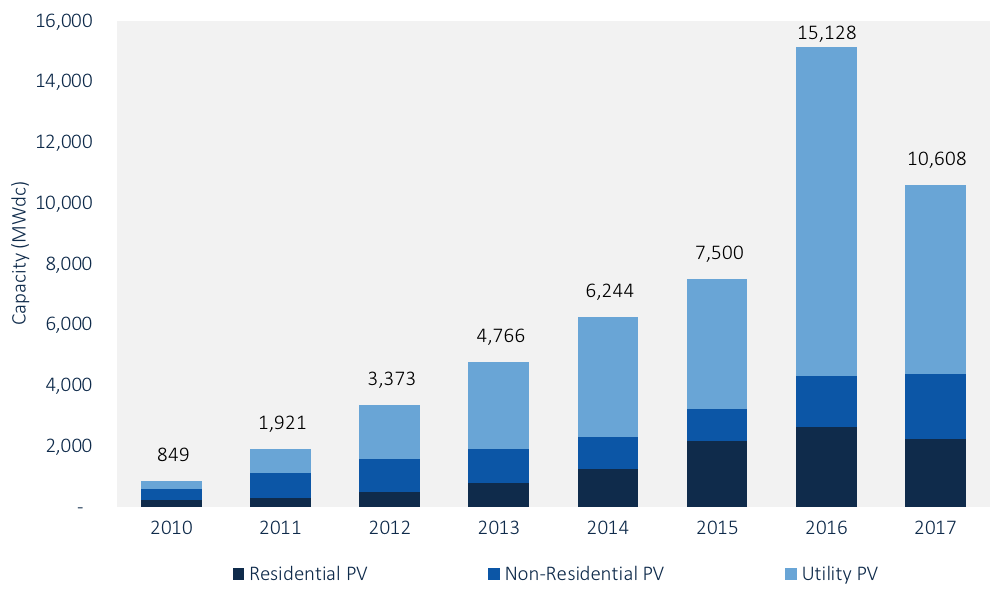 Source: GTM Research / SEIA U.S. Solar Market Insight Report[/caption]
"It's not rocket science,” Shugar said. “Until January, no one knew how much tar
iff penalty would be imposed on PV module costs. As a result, many projects were deferred.”
“Some projects died due to the added cost of modules, but fundamentals are still strong for the industry to rebound in 2019," Shugar added.
The reduced percentage of installed capacity can’t solely be blamed on the tariffs, however. Costa Nicolaou, CEO of PanelClaw, said 2017 suffered from the hangover from the last federal policy fight over the investment tax credit (ITC).
[caption id="attachment_8770" align="alignright" width="493"]
Source: GTM Research / SEIA U.S. Solar Market Insight Report[/caption]
"It's not rocket science,” Shugar said. “Until January, no one knew how much tar
iff penalty would be imposed on PV module costs. As a result, many projects were deferred.”
“Some projects died due to the added cost of modules, but fundamentals are still strong for the industry to rebound in 2019," Shugar added.
The reduced percentage of installed capacity can’t solely be blamed on the tariffs, however. Costa Nicolaou, CEO of PanelClaw, said 2017 suffered from the hangover from the last federal policy fight over the investment tax credit (ITC).
[caption id="attachment_8770" align="alignright" width="493"]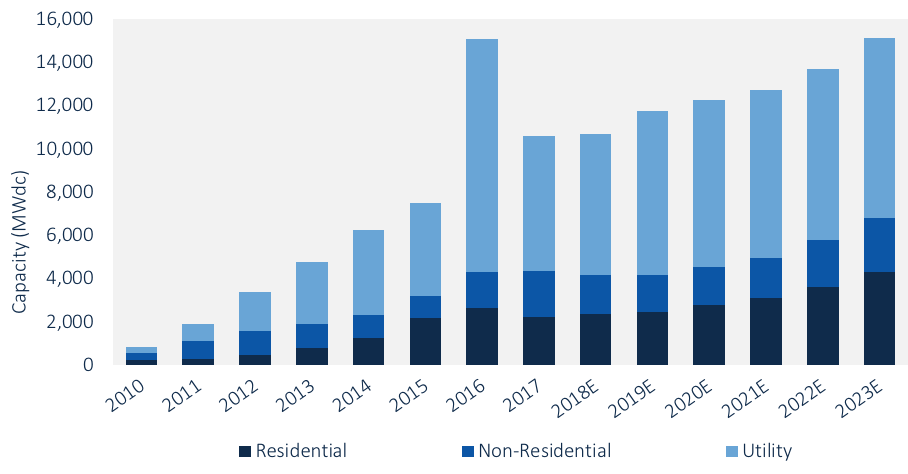 Source: GTM Research / SEIA U.S. Solar Market Insight Report[/caption]
"There was a lot of demand pull-in in utility scale at the end of 2016 because everyone assumed the ITC would end in 2016, so they moved their project timelines up significantly to make sure they could take advantage of it,” Nicolaou said. “Even despite that, 2017 had all the hallmarks of being a great year - then the Section 201 complaint was filed, and that dumped a bucket of ice water on our fire.”
But there is some good news in the report. After all, even though it doesn’t equal 2016’s incredible numbers, the industry did still install 10.6 GW last year. Furthermore, while the residential sector is cratering in many states and the utility-scale market is faltering, the commercial and community markets grew 28%, marking its fourth straight year of significant increases.
“We are excited to see commercial solar be one of the driving forces behind the continued growth of the industry,” said Tony Clifford, chief development officer for Maryland-based Standard Solar. “While no one expected last year to be as big as 2016, 10.6 GW is still a great accomplishment, especially in the face of such uncertainty.”
“This is yet more proof that the solar industry is on such solid footing that even difficult circumstances can't hinder its growth," Clifford said.
Jesse Grossman, CEO of Soltage, a New Jersey based developer of commercial
“We were heartened to see this report today, showing that solar continues to post strong annual build numbers even in years with stiff headwinds," said Jesse Grossman, CEO of New Jersey-based Soltage. "2017 saw a number of challenges to the solar sector, with the uncertainty of the trade case, pending tax reform, and a rationalization of business models in some parts of the residential sector.”
“The emerging development models in the utility-scale and commercial segments continued to show strong growth, however, and I expect that growth to continue again in 2018," Grossman added.
In all, the U.S. Solar Market Insight report is, as was likely expected, a mixed bag for the industry. But despite its struggles, the solar industry persisted. And sometimes, that’s all for which you can ask.
Source: GTM Research / SEIA U.S. Solar Market Insight Report[/caption]
"There was a lot of demand pull-in in utility scale at the end of 2016 because everyone assumed the ITC would end in 2016, so they moved their project timelines up significantly to make sure they could take advantage of it,” Nicolaou said. “Even despite that, 2017 had all the hallmarks of being a great year - then the Section 201 complaint was filed, and that dumped a bucket of ice water on our fire.”
But there is some good news in the report. After all, even though it doesn’t equal 2016’s incredible numbers, the industry did still install 10.6 GW last year. Furthermore, while the residential sector is cratering in many states and the utility-scale market is faltering, the commercial and community markets grew 28%, marking its fourth straight year of significant increases.
“We are excited to see commercial solar be one of the driving forces behind the continued growth of the industry,” said Tony Clifford, chief development officer for Maryland-based Standard Solar. “While no one expected last year to be as big as 2016, 10.6 GW is still a great accomplishment, especially in the face of such uncertainty.”
“This is yet more proof that the solar industry is on such solid footing that even difficult circumstances can't hinder its growth," Clifford said.
Jesse Grossman, CEO of Soltage, a New Jersey based developer of commercial
“We were heartened to see this report today, showing that solar continues to post strong annual build numbers even in years with stiff headwinds," said Jesse Grossman, CEO of New Jersey-based Soltage. "2017 saw a number of challenges to the solar sector, with the uncertainty of the trade case, pending tax reform, and a rationalization of business models in some parts of the residential sector.”
“The emerging development models in the utility-scale and commercial segments continued to show strong growth, however, and I expect that growth to continue again in 2018," Grossman added.
In all, the U.S. Solar Market Insight report is, as was likely expected, a mixed bag for the industry. But despite its struggles, the solar industry persisted. And sometimes, that’s all for which you can ask.
By Frank Andorka, Senior Correspondent What Happened: Teslarati got hold of aerial photos of Tesla’s Gigafactory near Reno, Nevada, which show
By Frank Andorka, Senior Correspondent What Happened: Teslarati got hold of aerial photos of Tesla’s Gigafactory near Reno, Nevada, which show
- Significant progress in the past few weeks on constructing what Elon Musk has said will be a 70 MW system on its roof.
- Plenty of work still needs to be done to make the system operational.
which will someday build the Model 3’s batteries and drivetrains.
Our friends over at Teslarati posted photos of the factory’s roof this morning to show…..an incomplete solar array. An array planned to be 70MW when completed. Why is that news? Who knows? But honestly, I don’t care - with Musk’s ability to generate free media, he will get more publicity for solar than anyone else in the space currently can.
(The one exception to that was last year, when two companies I won’t dignify by naming held the entire industry hostage for five months and got plenty of news coverage. Excuse me while I go get my blood pressure medicine, which I have to take every time I talk last year’s infuriating and unnecessary Section 201 fight.)
If the factory gets completed on time (it’s scheduled to be completed by 2020), it will be a shining example of what solar can do when its shackles are removed. Musk has promised the factory will be entirely powered by renewable energy. Here’s hoping that when they flip the switch on this rooftop, utility-scale power plant, Musk will ensure the world is watching.
Something tells me I don’t have to worry about that.
More
Tesla’s solar rooftop array at Gigafactory 1 is starting to take shape
By Frank Andorka, Senior Correspondent What Happened: The Federal Energy Regulatory Commission (FERC) passed a rule by a vote of 2-3 (no, we’re not sure how that’s a thing either) that
By Frank Andorka, Senior Correspondent What Happened: The Federal Energy Regulatory Commission (FERC) passed a rule by a vote of 2-3 (no, we’re not sure how that’s a thing either) that
- Tries to usurp the rights of states to set their own clean-energy goals.
- Privileges fossil fuels over renewable electricity sources by not accounting for the full value of energies like wind and solar.
which, in many cases, are supported by the government. The new rule, issued Friday, requires the minimum price stipulation to apply now to renewable sources.
The bottom line for renewables is that they are being penalized for being supported by state governments - but FERC deliberately ignores the state supports for traditional fossil fuel generation. So the order, instead of leveling the playing field as it purports, tips the field in the direction of fossil fuels and, in the process, usurps the states’ ability to support clean energy.
For those of you with short memories, FERC earned mad props earlier this year for rejecting a Department of Energy directive to subsidize nuclear and coal plants. The new order it issued Friday, however, essentially accomplishes the same thing without the negative publicity.
As Farmer notes, however, the rule isn’t final yet and will inevitably be appealed. So there’s still hope this odious rule won’t go into effect. But we best be vigilant because this rule could do significant damage to the renewables’ industries - and we must be ready to fight this with everything we have.
More
Miles Farmer explains the inexplicable FERC order that kneecaps clean energy
COSEIA. Join me tomorrow in Denver as I interview the team behind the Clean Energy Federal Credit Union, a project years in the making. What questions do you want to hear answers to? How can the lending community help your business?
Taxes and Tariffs. We will be talking a lot more about tariffs this week but it’s clear that tax reform and tariffs had a huge effect on the year solar had in 2017. Now that those things are figured out, people are back to putting their heads down and getting stuff done. Question for you, what is it going to take for C&I to get into the multi-MW scale?
Semis and Buses. I am intrigued by the business opportunities that electric vehicles present in our energy future. Made more interesting by the deployment of electric semis and buses in fleets of the future. First, electric vehicles are simply better. Second, we have a lot of work to do to enable the fleets to not be affected by long duration charging. My guess is we are a few years from energy demand growing in the US.
He Is Back. Arnold, man of many accomplishments, has a major task ahead of him. He is suing the oil companies for their failure to disclose the health risks of climate change. Comparing it to the tobacco companies, he wants to use civil litigation to drive some change. I wonder if he’s been approached to help the solar space.
San Francisco. We will have some big news including another speaker for Wakeup Live SF this week, mark April 10th on your calendar to join your colleagues.
Have a great day!
News
Opinions:
Have a great day!
Yann