
A Behind the Scenes look at SolarWakeup

A Behind the Scenes look at SolarWakeup

By Yann Brandt, Managing Editor

Behind-the-Scenes-Logos-and-Partnerships_1The most common question I get about SolarWakeup is how I do it. How do the 9 articles and the morning thoughts get put together so that they hit your inbox at 7am eastern time, 6 days per week? After SPI in Las Vegas, I figured it was a good time to give you a behind the scenes look at how the wheels turn.

To see where it all started, you have to go back to August of 2012. I had just begun a startup and knew I would be somewhat absent in solar for sometime so I pondered ways to stay relevant to the solar industry. Emulating Florida’s Sayfie Review, I told my wife that someone should do this for solar, when she had the brilliant idea that I should be that someone.

So on August 24th, 2012 I wrote 15 of my closest solar friends the first of 675 SolarWakeup newsletters (as of 11.17.2014). Today, the list stands at over 2,000 readers who get the 9 articles and 1 thought (100 words or less) each morning. On average almost 30% open the email every day and 11% click on the link within the email. Some of you go directly to the site and then read about 1.7 articles while there.

Your biggest complaint is that the links don’t open into a new tab and when I post an article by Fox News or Washington Times. My biggest complaint is when you don’t publish enough content which makes my part of the process more time consuming (I call this the Monday morning mashup). Your favorite part is telling me how wrong one of the authors is or to give me a scoop, which is my favorite part. I have enjoyed the few exclusives or breaking news that I was able to break ahead of actual reporters and I always love giving advice to companies and executives on how to improve their content.

One fact that is often misunderstood is that I have a daytime obligation, an amazing job with a great company and team (find me on LInkedin if you want to talk work). SolarWakeup is not my job and I do not monetize it, mostly because I want to be able to write what I think is most valuable and not be beholden to the bottom line. I actually spend quite a bit of money to keep the wheels turning but I feel compensated by your thoughts and feedback and the random notes of encouragement.

The biggest secret of SolarWakeup is that I do it at night. At some point between 8pm and midnight, I pull out the laptop and find the articles. Initially I woke up at 5:30am and found the articles then, but my friends know that 5:30am is not my friend and the additional content published overnight is not that relevant.

So I wherever I am, I get in front of the computer at night (eastern time) and find the articles. I find the articles in this order

  • Use worthwhile content that was emailed or tweeted to me that day
  • Insert any original stories that readers, contributors or I wrote
  • Go through my list of ~30 Google news saved keywords like: solar, solar+Romney, solar + report, solar + letter, solar + nytimes, etc.
    • This step typically gets me to about 4-6 articles
  • Start going through my list of solar related websites

The list of solar websites is somewhat of a ranking decided by your clicks. I see the articles you are most interested in and reorganize the list of websites according to the success of the clicks. I also adjust based on my judgment so if one site is being particularly promotional or burying specific company (advertiser) info in the article, I push them to the bottom of the list. Some sites also get ranked according to the author so it could be at the top if it is a particular contributor.

Then comes the part about writing the blurb/morning thought. There is little pattern to it but the ultimate goal is to create solar camaraderie or drive action from the readership. I feel like this is the opportunity for all readers to think about the same topic for 30 seconds per day.

Let’s talk logistics. I travel a lot for work, which means that I can be found doing the Wakeup at all sorts of hours, sometimes at noon if I am in Asia. Using SPI in Las Vegas as an example, I would visit with colleagues/clients at dinner, meet up for some drinks and attend a party hosted by supplier. Then when everyone is ready for sleep, I open up the laptop and find the stories. Sorry for the typos….

It has been a great road for the past 2 years plus and it will keep going. I often think it would be great to work with other media platforms or do more original stories. I truly enjoy doing the Wakeup and there are many people to be thankful for that have helped me get here. I hope this quick look behind the scenes was everything you ever hoped it would be. Of course if it leaves unanswered questions, just hit reply on your next SolarWakeup email and it comes straight to me!

See you at 7am!

Top 10 Solar States to Watch

Top 10 Solar States to Watch

Where are homeowners most interested in residential solar power?

By Scott Mueller, Special to SolarWakeup

Residential solar is the fastest and most steadily growing market segment with year on year growth well over 50%.

Over the last few years the solar industry has come a long way, as illustrated in the recent SEIA US Market Report. Numerous residential solar installation companies pepper the Inc. 5000 fastest growing companies list, and the successful IPOs of SolarCity and forthcoming Vivint Solar reflect this growth and optimism. We think the best is yet to come.

The megawatt question is where will we see new residential solar growth in the coming year?

In states like California the right mix of policy, market conditions, and consumer interest show how the market can grow quickly and sustainably, and California shows no real signs of slowing. As solar begins to reach the mainstream, and 92% of Americans want more solar, we all want to know which states represent the next wave.

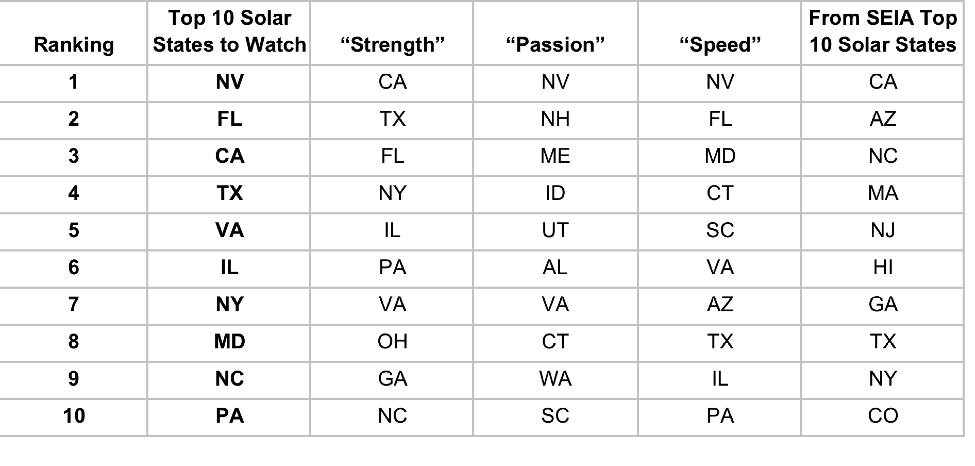
So we did a little data crunching on our own residential solar lead data from the last eight months. We call it the “US Solar Combine”, where States are ranked in three events:

  1. “Strength” – Top states by total solar lead volume
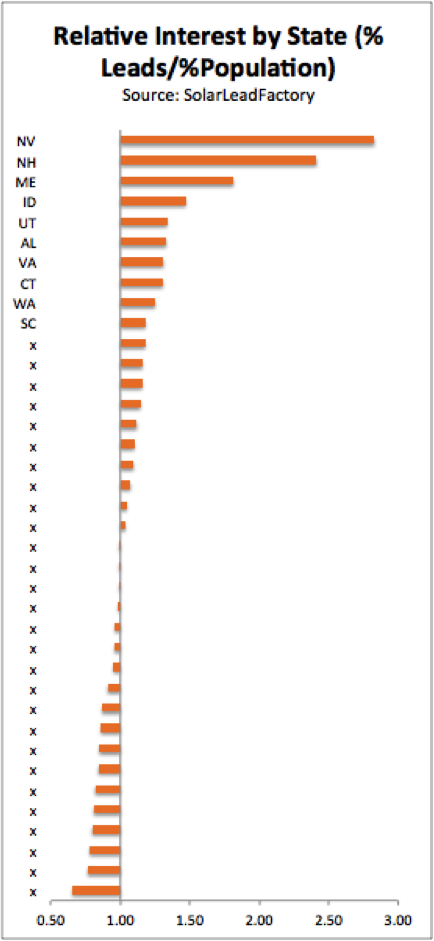
  2. “Passion” – Relative interest level in solar power (ratio % of leads/% of population)
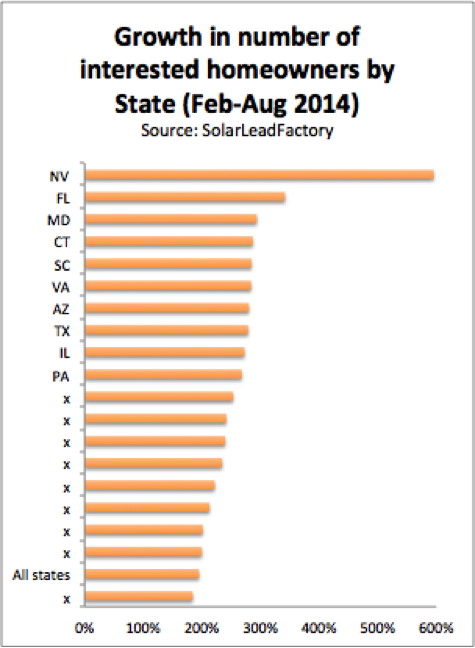
  3. “Speed” – Fastest rate of solar lead growth in the first 8 months of this year.

Then we took an aggregate score of all three events to crown the overall champion. You’ll be surprised to see how they stack up.

#1. STRENGTH: Top State by Total Lead VolumeSM 10 States 1

The first test is brute strength—who’s got the most interested homeowners?

Here we’re looking at the relative percentages of residential solar leads by state in the USA, which is of course heavily influenced by population (bigger states will generally have more leads). So the Golden, the Lone Star, the Sunshine, and the Empire states live up to their big names and take the crown as the strongest states by lead volume.

But if California represents about 50% of the residential solar market and only 10% of the lead volume (much more in line with population), then doesn’t this say that people across the country are roughly equally interested in solar? We think that with the right long-term strategies in place, Texas, Florida, and New York would easily rise to become some of the major markets. New York is already taking big steps to become a major solar market, while Florida and Texas have alternated between glimpses of their true potential and stumbling. The people have spoken, so let them have solar.

Winner: California, the Golden State

Runner-Up: Texas, the Lone Star StateSM 10 States 2

#2. PASSION: Top ranked states by “interest”

The second test is more nuanced—what state has the most solar passion?

It’s not surprising that California is the largest lead volume state, so we needed a measure of how many people are saying, “I want solar,” compared with that state’s population. The higher the score, the greater the relative interest level in solar.

This is calculated as % of residential solar customers divided by % of population. This is an indication of the latent demand for solar, with “1” meaning equal percentages of people want solar and who live in that state (e.g., (10% of the total leads) / (10% of the US population is in that state) = 1). Simply stated, the greater the value, the higher the concentration of people who want solar.

Nevada, New Hampshire, and Maine have a much higher proportion of people that are interested in solar than say New Jersey or Louisiana. While there are robust solar markets in states with lower “solar passion scores,” this test points out some of the true outliers in public opinion.

Winner: Nevada, the Silver State

Runner up: New Hampshire, the Granite State (or Live Free or Die)

#3. SPEED: And the fastest growing states are…SM 10 States 3

The third test was outright speed—which states are seeing the fastest rate of lead growth?

The more mature markets saw rapid growth; in fact, over the first half of the year, interest in solar as seen by number of residential solar leads has almost tripled! But some markets are clearly winning the 40-yard dash: Nevada was the Usain Bolt of solar interest with an almost 600% increase in interested homeowners from January 2014 to August 2014. Florida was well over 300% growth, and all of the top 10 states clocked in over 250% growth. And all of the states with a significant lead volume at least doubled in lead volume. This is pretty monumental and suggests that indeed the biggest solar wave is yet to come.

Winner: Nevada, the Silver State

Runner Up: Florida, the Sunshine State

RESULTS: Combined scores in each of the three disciplines

So far we’ve seen California take the crown as the “Strongest” state, but Nevada had the most “Passion” and was also the “Fastest.” As with any combined event, it’s all about how you did in as many events as possible. The results of our three disciplines and the combined ranking are posted in the table below as well as how SEIA ranked the states in 2013.

Nevada, the Silver State, eked out the first place position by winning two out of three events. However, Florida, the Sunshine State, managed to snag second place based largely on their strength (third, just behind Texas) and speed (second). To boot, Florida ranks third in terms of solar potential in the USA (according to SEIA). California lands in third, just barely edging out Texas. Virginia wraps up the top five, with Illinois, New York, Maryland, North Carolina, and Pennsylvania rounding out the top ten.

With over half of all residential solar installations in California, new state markets represent the next major growth opportunity for a sustainable, healthy, and growing U.S. solar market.SM 10 States 4

This data was collected and analyzed by Solar Lead Factory, a solar-focused residential lead generation business leveraging online marketing strategies. The analysis here was based on a data segment of comprehensive US-based web traffic.

The views and opinions expressed on this web site are solely those of the original authors and other contributors. These views and opinions do not necessarily represent those of SolarWakeup.com, and/or any/all contributors to this site.

Wall Street and Main Street Voted. Clean Energy Won.

Wall Street and Main Street Voted. Clean Energy Won.

By Jonathan Silver, Special To Solar Wakeup

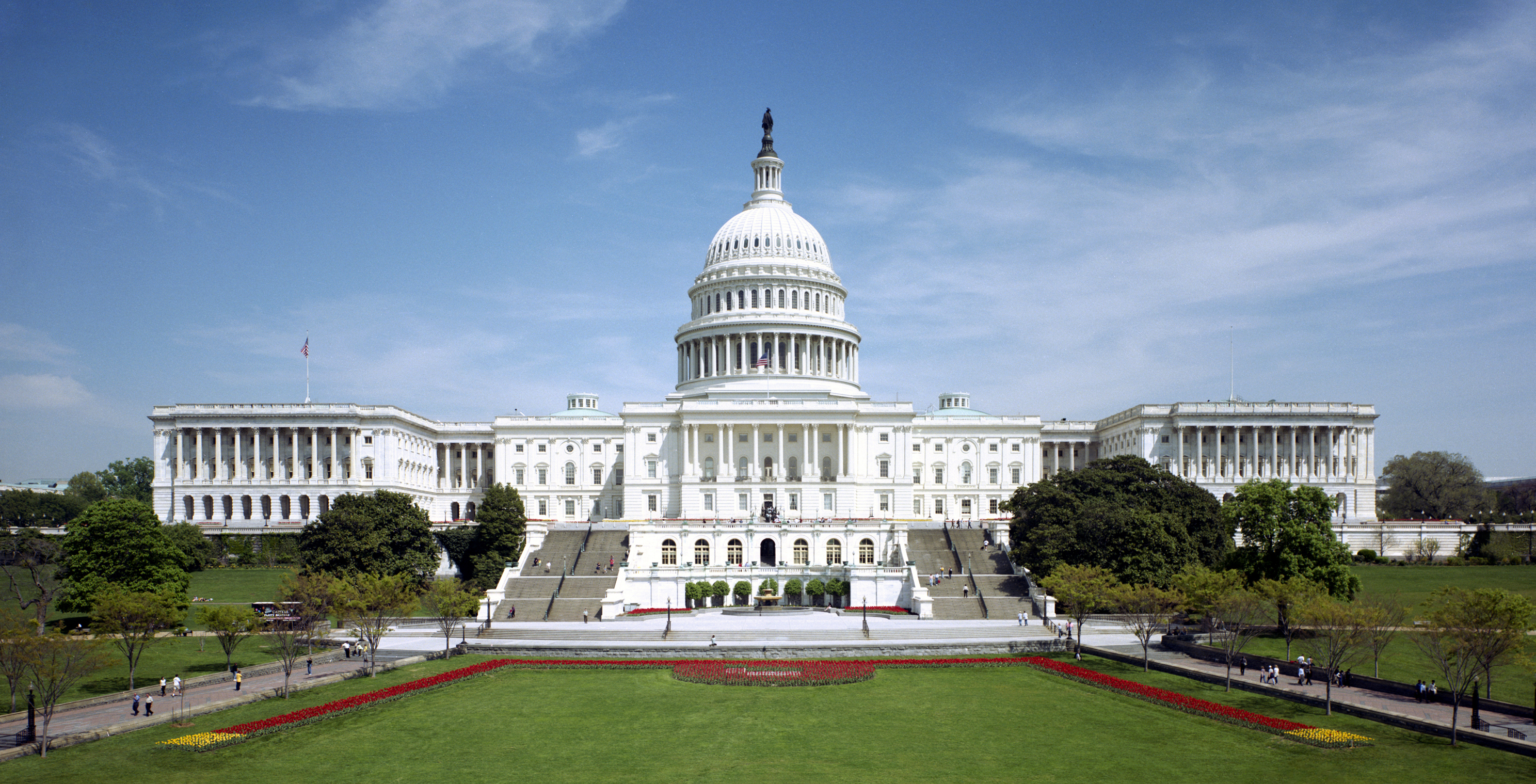
US Capitol

“Wall Street and Main Street have voted. They voted for a clean energy economy. As any good investor knows, you back your winners.”

When Congress returns after Labor Day, it will pick up the debate over the clean energy provisions (like extending the production tax credit, clean energy depreciation benefits and alternative fuel tax credits) in the tax extenders package. But, as in so many areas, Washington is behind the curve.

The debate is over. Clean energy won.

What Americans want is clear. Despite the histrionics on Capitol Hill, the disdain of the fossil fuel industry and the misplaced focus by the media on the politics of the fight, clean energy is on its way to becoming the dominant form of power generation in this country.

The trend is unmistakable. According to Bloomberg New Energy Finance, wind, solar, geothermal, biofuel and hydro now generate 13% of the energy we use. Nuclear adds another 19%. Almost a third of all our domestic power now comes from carbon-free and renewable sources.

Since 2007, US coal consumption, driven largely by the lower cost of natural gas, has fallen by more than 20%. New EPA regulations, based on the social, or true, cost of carbon, will further reduce the use of coal. This, too, will increase the use of renewables.

Natural gas, is, itself, becoming more expensive relative to renewables. The cost of fracked gas is already increasing as regulatory protocols are established and infrastructure and transport costs increase. Just ask New England homeowners, where natural gas prices spiked six times higher than normal last winter.

At the same time, the cost of renewables continues to fall. Solar panel costs have fallen by more than 70% in the last 5 years and panel efficiencies are increasing. New panel composites, wind turbine designs, and battery storage chemistries are reducing manufacturing costs quickly. Installation costs are also dropping.

As costs come down and concerns around energy security increase, public support for renewable energy has grown. A recent poll by Yale University found that 87% of Americans believe Congress should make developing sources of clean energy a priority and 68% think we should regulate carbon dioxide as a pollutant. Similarly, a Gallup poll found that more than 70% of all Americans thought the US should put more emphasis on solar and wind energy production. By contrast, only 31% believe we should focus more resources on coal.

The data is even more pronounced by cohort. A League of Conservation Voters poll found that more than 80% of American youth support an aggressive climate change agenda, with its strong implications for clean energy. A National Council of La Raza poll found that 90% of Latinos favor clean energy over fossil fuel and 83% say that coal and oil are “a thing of the past”. Both groups will play a major role in energy decision-making in the future.

Consumers are speaking with their wallets. There is a 6-month backlog for the Tesla S and the Chevy Volt. With higher CAFE standards pushing manufacturers towards hybrids and EVs, today nearly every car manufacturer in the world offers some form of hybrid or electric vehicle and the US market for hybrid vehicles, the largest in the world, is doubling every 3-4 years.

Why? With no gas bills and lower maintenance, the total cost of ownership of an electric vehicle is now about 1/3 lower than the price of a traditional car. Vehicle range issues are now mostly a matter of perception. Most of the EV’s on the road today can travel more than 100 miles on a single charge, but 99% of all trips in cars are less than 70 miles and 15% are less than 1 mile.

There are also more charging stations than many realize. Recargo, a company providing data on public charging stations, covers over 20,000 locations in the US and Canada. Even Disney World has electric charging stations!

Energy conservation has also gone mainstream. Over 53 million smart meters have been deployed. Building owners increasingly use sophisticated energy management tools to cut costs. Last year, Google bought Nest, a smart home technology company, for more than $3 billion and OPower, a public company which provides consumers with energy use data has a market cap of over $700 million.

The financial markets have taken notice. In 2013, the NEX, a global index of publicly traded clean energy companies, was up almost 54% while the S&P rose 30%. Yieldcos from NRG, Pattern Energy and others have had successful IPOs. Municipal “green” bond offerings are oversubscribed and investors have put hundreds of millions of dollars into residential solar roof-top loan administrators like Renewable Funding and Renovate America.

Wall Street and Main Street have voted. They voted for a clean energy economy. As any good investor knows, you back your winners. Washington would do well to listen to the voters and continue to support this important and rapidly growing sector.

Mr. Silver is one of the country’s leading investors in the clean and renewable energy sector. Most recently, Mr. Silver served as a Senior Distinguished Fellow in Energy at Third Way, a leading think tank. He is the former Executor Director of the DOE’s Loan Programs Office and led the Obama Administration’s $40 billion dollar investment program in alternative energy, financing a wide range of solar, wind, geothermal, biofuels, fossil and nuclear energy projects. He also headed the government’s investment program in advanced automotive technology making significant investments in transmission and electric vehicle manufacturers including Ford, the Nissan Leaf and Tesla Motors.

The views and opinions expressed on this web site are solely those of the original authors and other contributors. These views and opinions do not necessarily represent those of SolarWakeup.com, and/or any/all contributors to this site.

All The Numbers Of The Vivint IPO You Need To Know

All The Numbers Of The Vivint IPO You Need To Know

By Yann Brandt, Managing Editor

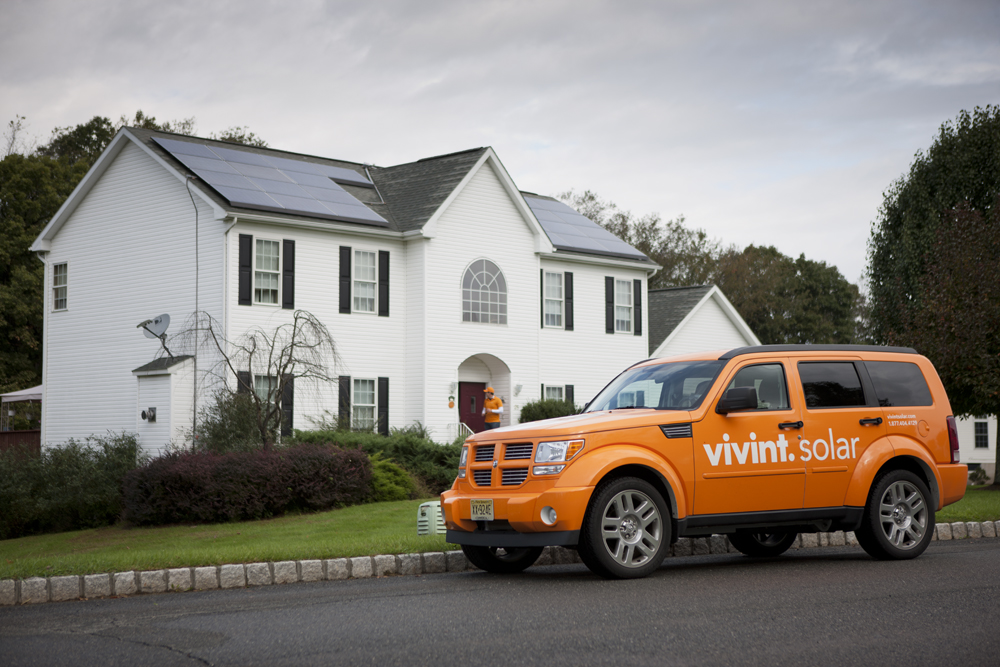
vivint-solarAccording to the filing, ALL of the systems installed by Vivint Solar use Enphase inverters … That means, Vivint Solar bought over 215,000 Enphase products in 2014″


Residential solar has been growing at a pace beyond anybody’s expectation. With SolarCity’s IPO less than a year behind us, Vivint Solar hopes to go public in its latest round of fundraising. While there are comparable data points, Vivint Solar and SolarCity have distinctions as well. From markets, financing products to technology, we break down the Vivint Solar IPO filing, also known as the S-1 filing.

Vivint Solar is owned by Blackstone L.P., a global investment and advisory firm with about $279 billion dollars in assets, as part of the deal where Vivint was sold for  around $2 billion. Vivint is labeled in the IPO as a sister company, focused on providing residential home security systems and services to over 850,000 customers throughout the US. Vivint Solar is expected to trade under the ticker $VSLR and Blackstone will remain the majority owner of the company. Vivint (home security unit) will not be part of the IPO process.

The Market Information

Vivint Solar is currently operating in 7 States including: Arizona, California, Hawaii, Maryland, Massachussets, New Jersey and New York. In 2014, the company expects to open 20 new offices in new and existing markets. Our guess is that Vivint Solar will follow in SolarCity’s path and enter markets where they are not yet overlapping, such as: Nevada, Connecticut, Colorado, Washington D.C., Delaware, Oregon, Pennsylvania and Texas. Of course each State has a timing issue around incentives and costs of electricity which would determine the value of entering the new market.

Vivint Solar maintains a unique sales approach, employing mainly direct sales personnel (canvassing) signing customers up by knocking on doors. The company has 489 salespeople, many of which came from the sister company. After the IPO, the movement of personnel could be limited in a non-poaching relationship. However, the two companies will pay lead referrral fees to each other to help the synergies continue. Keep in mind that Vivint has 850,000 customers and Vivint Solar has only penetrated 2.5% of that amount with 21,921 customers, meaning there is a lot more room for growth from that channel.

Financial Products and Customers

Being a part of Vivint and Blackstone is not without advantages. Financially, Vivint Solar maintains access to a credit line of $70 million dollars from Vivint and the Blackstone relationship brings financial crediblity to the table. Viving Solar currently lists $443million in funds and 53MW of tax equity available to invest. To date, Vivint Solar has contracted with 21,921 customers, with 8,625 customers signing in 2014 almost doubling all of 2013. Keep in mind that SolarCity signed up almost 30,000 customers in Q2 of 2014, still a wide gap. On a total basis, $VSLR has 129MW of systems, bringing the average to 5.9kW though the 2014 average is 6.6kW.

From a financial product standpoint, Vivint stands out. As of June 30th, Vivint has not contracted any leases. Meaning that their projects were done through power purchase agreements (PPAs) with some cash sales likely. The leases will encumber the balance sheet with a production warranty similar to the other market participants. The PPAs are averaging a 2.9%-3.9% annual escalation. Customers are still leaning towards the higher end of the credit risk, with an average FICO score of 750.

Solar Installation Technology Specifications

From 2013 to 2014, the average system size increased from 5.9kW to 6.6kW. The assumption would trend that the increased volume made purchasing higher efficiency panels feasible. Vivint states that the top manufacturers as Yingli and Trina; solar trade tariffs are listed as a risk item but no explicit purchasing strategy is mentioned that would signal a departure from current module suppliers. From a technology risk point of view, Vivint specifically mentioned the Zep acquisition by SolarCity and what it meant losing access to their preferred racking vendor. It appears that being committed to a single supplier is a risk Vivint Solar is willing to continue taking by looking at their inverter purchasing.

Enphase is the preferred inverter choice for Vivint Solar. According to the filing, ALL of the systems use Enphase microinverters. With 30 thousand residential solar installations at this point, that is a lot of Enphase product, and one question we had was exactly how much of North American product went to Vivint Solar. By reviewing the quarterly filings released by $ENPH, we were able to estimate 867,850 inverters sold to the North American market in 2014. During that same timeframe, Vivint Solar installed 8,625 systems/56.9MW with an esimated 25 panels per system. That means, Vivint Solar bought over 215,000 Enphase inverters or 25% of the total North American sales by the company. A risk for both companies for technical and business purposes for sure. Will investors be concerned or ask for a strategy to mitigate the risk seeing that no system has been operational for longer than 3 years thus far.

Financial Position and Review

The balance sheet seems strong, so let’s review the key metrics we are becoming accustomed to seeing from solar asset owners. $VSLR is sitting on $25 million dollars in cash and has credit lines of $57 million with interest rates between 7.5% and 12%. Each individual contract represents a contracted cash flow, meaning that Vivint Solar currently has $647 million dollars in outstanding contracted revenue.

Retained value has become the metric that is not yet standardized across peers. At the last quarter, SolarCity called for a retained value of $1.76/watt while Vivint Solar calls theirs $2.39/watt. At this point, it probably means comparing apples and oranges but will continue to sort itself out.

The IPO

Vivint Solar is ready for its IPO, or so the executives and owners seem to think. The solar industry wants the IPO to succeed, mostly because another strong round of capital injection will support the retail investment thesis that solar represents. Having two comparable publicly traded solar companies is a good to have in the limelight, as more homeowners look to add solar to their home.

Getting the IPO out will be the key, there are challenges ahead which may not be related to solar but how the deal is structured. Remember, SolarCity barely made it out in a more difficult financial climate when it went public at $8 per share. Today, trading at almost 10x that number, we see the financial market ready to bring another company on. But the hope remains that the other peers in the downstream finance space follow and make the IPO leap.